Sarah Adams: “It ain’t what you lose, but how you gain it in translation...”
Maybe contrary to popular opinion – or do I mean unpopular opinion? Either way, it’s not like I’ve carried out a survey – the pun is a challenge I always relish when faced with a new translation; in fact, I would go as far as to say: the more the merrier.
There are many reasons for this, as I see it, but mainly it is because I have very much come to believe in Sarah Addams’ above philosophy. I also take Lena Kaarbebol’s point, the Danish writer of children’s stories. She translates her own books into English: “Translation is impossible,” she states, but “Transformation is not.” She sees translation as one more re-write; or a “writer’s tool”, with which she is able to “gain new insight into what my characters might say or do” – she sees the story afresh! More importantly, she says: “Language is bound up with the way we see the world. And despite teasing similarities, even the most closely related languages do not match, word for word. A switch in language means a switch in perception.”
Indeed, it is armed with these last two sentences that I approach any play-on-words. And while I do not normally adhere to the concept of believing that the original author is sitting beside me – ‘this is what the author would have written, here, today, were s/he writing in English’ – I believe that translating the pun is where we, as translators, shouldn’t feel too guilty in allowing ourselves that romantic privilege – all translators do it in spite of themselves, I am sure.
Without resorting to a dictionary, or another quotation, I need firstly to ask just what a pun is and its intention. Actually, I prefer to think of a ‘play-on-words’, for such a title offers me at least two clues to go at: ‘play’ and ‘words’. Having fun with words, then? This, however, should not distract me from the pun’s possible intention, which could be anything from comical confusion – staged farces couldn’t live without them – to corrosive satire – extract the puns in Swift’s Gulliver’s Travels and we’d be left with half a book.
But I do believe that Lena Kaarbebol’s wise words offer that handy “tool” with which to approach the pun, which either works by a rare literal translation, or by creating another pun – all depending upon its satirical importance. Or it doesn’t work at all, in which case I might look to ‘compensate’ with a preceding or subsequent sentence – gain something elsewhere in translation, as Sarah Addams might put it. After all, as Phyllis Zatlin rightly points out: ‘A pun that is not translated as a pun stills yields its information content.’
Bearing in mind Laurence Venuti’s very valid concerns about the status of the translator today – which isn’t a good one – I guess what I’m trying to say is that a translator should strive to get as much fun out of translating as possible. Language is bound up with the way we see the world, and conceptual metaphor, the proverb, the pun, are all ways in which we have the possibility to delve right into the spirit of the text – why not imagine the source text author is looking on with a smile?
As for the pun, then, my strategy is a simple one: if nothing comes to mind immediately – which is rare; I tend to work quickly – then I move on, leave it to the subconscious process; something will come along in the next 24 hours, rather like the source text author might work.
For Tom Stoppard’s play The Invention of Love, I did just that: met with my first ‘hurdle’ on page 3 and decided to move on:
AEH: ‘[...] There are places in Jebb’s Sophocles where the responsibility for reading the metre seems to have been handed over to the Gas, Light and Coke Company.’
The salient word being ‘metre’ – either poetic beat or something we might once have put a shilling in.
My response was:
« Il ya des parties dans le Sophocle de Jebb où la responsabilité concernant la scansion semble avoir été mise en place en accordance avec les mesures de sa taille. »
My gloss is:
‘It there has parts in the Sophocles of Jebb where the responsibility concerning the scansion seems to have been put in place in accordance with the measurements of his waist.’
What is the purpose here of Stoppard’s pun? Primarily to make the audience laugh. One doesn’t put money in a ‘metre’ in France exactly, so I chose to play with ‘mesure’ – ‘measurement’ in English – which can be used for poetry as well as clothes sizes. If I’ve managed to keep with the theme, yet chosen to play with a different word, then perhaps I’ve attained my goal with part compensation. I believe the translation works equally well.
A pun I was actually able to put to the test earlier this year, on a real live French boy, was my translation of a chapter from children’s author Roald Dahl’s The BFG – now here’s a writer who enjoyed his word play! And rightly so: nobody appreciates a pun more than a child; I think it’s the thrill of getting it. My daughter loves this one in particular:
‘Meanings is not important,’ said the BFG. ‘I cannot be right all the time. Quite often I is left instead of right.’
The translation I tested on the French boy reads:
« Les signifiances n’avons pas d’importance, dit le GGG. Je ne peux pas toujours avoir des raisons. Des fois c’est plutôt des raisins. »
Here is something of a part back/part literal translation:
‘Meanings has not any importance, said the BFG. I cannot always have reasons. Sometimes it’s more like grapes.’
The ‘left’ and ‘right’ wordplay was out of the question, but again I was able to work with the same sentence, and add to the theme of food: ‘avoir raison’ – translating as ‘to be right’; literally ‘to have reason’ – and ‘avoir raisins’, literally ‘to have grapes’. Once more, if something was lost, something else was gained – Roald Dahl is one of those writers I can’t help but feel is sitting beside me! As for my little French friend, well, his mum tells me he now uses it at parties.
Very free rewriting is better than omission, I have heard said somewhere, I just can’t remember where... And as I sit here writing this blog, keeping in mind all I have said, I arbitrarily turn a page of Lewis Carroll’s The Annotated Alice and meet with:
“Why did you call him tortoise, if he wasn’t one?” Alice asked.
“We called him Tortoise because he taught us,” said the Mock Turtle angrily. “Really you are very dull.”
Still looks scary out of context, doesn’t it... but that’s all it is, out of context. I must have a go at translating the book one day.
Bibliography:
Sarah Addams and Lena Kaarbebol quotations taken from a copy of Outside in, Translating Children’s Literature
Tom Stoppard’s The Invention of Love, 1997, Faber and Faber
Roald Dahl’s The BFG, 1996, A Ted smart Publication
Phylis Zatlin quotation taken from her Theatrical Translation and Film Adaptation, 2005, Multilingual Matters Ltd
The Annotated Alice, Lewis Carroll – chapter provided by BJ Epstein
Biography of Chris Rose:
After graduating in French Language and Literature with subsidiary Spanish from The University of Sheffield, I have mainly taught English, in London, on the south east coast of England, and in France, where I lived for nearly eight years. It was in France where I also began to write, completing a novel as well as a number of short stories. I’ve also dabbled in children’s stories – not the easier option some might believe.
I am currently reading for a Masters in Literary Translation at The UEA, where I am able to combine just about all my language interests in the one package; it is a course I’d recommend for any budding novelist/poet/ translator...
Monday, 16 January 2012

Monday, 9 January 2012
Belay the translator!
One of the things I have enjoyed about studying Literary Translation is being given texts that I have never been faced with before or would never have thought myself capable of doing. From nonsense rhyme to a psychological thriller, we have had a wide range of texts put in front of us. But there has been one genre that I knew was going to be quite a challenge for me: Drama. Everyone who goes to school in England will have had their fair share of Shakespeare. I completed my secondary education in Turkey and we did not study English Literature. The fact that I have never studied the genre I’m translating may not be such an issue; I can read the play and get a sense of what is going on and the style it has been written in. But no, the play in question is Tom Stoppard’s The Invention of Love. For all I know I may as well be translating Carroll’s Jabberwocky again! But at least those were made up words. This is nonsense in a language that I can actually speak. I have never really felt at a disadvantage before when translating from or into English. But this time I’m not so sure of myself. As for the references, those are a completely different matter.
I start translating the first two lines into Turkish and already there is a problem.
Charon ‘Belay the painter there, sir!’
From the introduction I already know that someone is approaching the bank of the Styx. I look up what ‘belay’ means and it turns out to be a term that means to fasten or secure. So there’s a painter approaching the bank of the Styx and Charon is ordering someone to moor the boat. After having translated about a page or more I realise that this person is not actually a painter, but a Professor with a possible personality disorder. And that the reference to ‘the painter’ is the Victorian art critic John Ruskin who appears a few lines down in the play. There are many more references to Oxford and mythology in the text which makes it especially difficult when translating for a Turkish audience. I do not want to under mind them but I doubt they would get the references at all. What do I do then? Do I try and find an equivalent, or do I just leave it as it is? The setting of the play is so particular I think I need to leave it as it is, plus there is no equivalent that I can think of. Another aspect of the text that I thought might be a problem was the use of Latin and Ancient Greek. This is where I feel at a disadvantage on behalf of my Target Culture. I am afraid of having already alienated them with my references to Oxford and now they have to struggle with dead languages. But wait, Stoppard has saved me the trouble and has provided translations in English. All is not lost after all!
Of course there are many other issues related to the translation of Drama. I have to think about the target audience of the text. Is this going to be read by an academic or am I translating for the purpose of a performance? Does the dialogue flow as well as in the original? Should I just trust my language abilities and leave the rest to the audience?
After all this complaining I am glad I got given this assignment. As translators we may not always (or never) be lucky enough to pick what we want to translate and should be willing to give different genres a go. However hard I found the translation of this play, I have not thrown the towel in yet with Drama. Although next time I might start with something a bit easier!
Selin translates from French and Turkish into English. She is currently studying the MA in Literary Translation at UEA where she did her undergrad in Modern Languages. Her literary interests include magical realism and crime fiction and she occasionally translates Turkish poetry.
I start translating the first two lines into Turkish and already there is a problem.
Charon ‘Belay the painter there, sir!’
From the introduction I already know that someone is approaching the bank of the Styx. I look up what ‘belay’ means and it turns out to be a term that means to fasten or secure. So there’s a painter approaching the bank of the Styx and Charon is ordering someone to moor the boat. After having translated about a page or more I realise that this person is not actually a painter, but a Professor with a possible personality disorder. And that the reference to ‘the painter’ is the Victorian art critic John Ruskin who appears a few lines down in the play. There are many more references to Oxford and mythology in the text which makes it especially difficult when translating for a Turkish audience. I do not want to under mind them but I doubt they would get the references at all. What do I do then? Do I try and find an equivalent, or do I just leave it as it is? The setting of the play is so particular I think I need to leave it as it is, plus there is no equivalent that I can think of. Another aspect of the text that I thought might be a problem was the use of Latin and Ancient Greek. This is where I feel at a disadvantage on behalf of my Target Culture. I am afraid of having already alienated them with my references to Oxford and now they have to struggle with dead languages. But wait, Stoppard has saved me the trouble and has provided translations in English. All is not lost after all!
Of course there are many other issues related to the translation of Drama. I have to think about the target audience of the text. Is this going to be read by an academic or am I translating for the purpose of a performance? Does the dialogue flow as well as in the original? Should I just trust my language abilities and leave the rest to the audience?
After all this complaining I am glad I got given this assignment. As translators we may not always (or never) be lucky enough to pick what we want to translate and should be willing to give different genres a go. However hard I found the translation of this play, I have not thrown the towel in yet with Drama. Although next time I might start with something a bit easier!
Selin translates from French and Turkish into English. She is currently studying the MA in Literary Translation at UEA where she did her undergrad in Modern Languages. Her literary interests include magical realism and crime fiction and she occasionally translates Turkish poetry.
Monday, 2 January 2012
The Mystery of Translating Crime Fiction
It is my view that in order to translate a literary text, it is necessary to have some understanding of its genre. Given that conventions can differ between cultures, a translator should ideally have read a number of texts from that particular genre in both the source and target culture before beginning to translate.
Crime fiction is a genre which has been hitting the top of the bestseller lists for a while now and novels of this kind from Scandinavia in particular have seen an impressive rise in popularity. Translated crime fiction, therefore, currently fills the shelves in bookshops and in libraries. So it seemed to me, as an aspiring translator, important to consider the characteristics of crime fiction and some of the challenges involved in its translation.
What did I already know about crime fiction before I began reading about it academically for the Case Studies module? As a library assistant, I know only too well that crime books are extremely popular. Not only that, people who read crime fiction do not generally pick up one book with a yellow ‘CRI’ sticker on the spine and then head for a different section of the library. They select a stack of crime books. They read an entire series from start to finish. They read every book ever written by one author then move on to the next author ‘who writes like’ the first. Crime fiction is addictive and this I have learnt from experience. I was brought up to read about and indeed watch Hercule Poirot exercising his “little grey cells” and have recently devoured twenty novels about M.C. Beaton’s middle-aged amateur detective, Agatha Raisin. And this was all before I was introduced to the unputdownable chilling thrillers by Sophie Hannah.
In fact, crime fiction has long been criticised for its formulaic nature and as a result has traditionally been classed as ‘low’ literature. However, as I have already identified, crime fiction is a popular genre and I would even argue that this could be due to its formula as readers step into the detectives’ shoes and attempt to solve the riddles, which they know will undoubtedly be solved by the end of the final chapter. It could be that readers are most attracted to the charismatic nature of the hero or the gripping plotlines with their anticipated unexpected twists and graphically violent scenes.
Or perhaps the popularity of these works of fiction stems from the honest and often brutal portrayal of real life. As B.J. Epstein discusses in the article ‘Girl with the Dragon Translation: Translating Thrillers and Thrilling Translations’, through the portrayal of crimes and the reactions to them as well as the specific language used by crime authors, the reader is given an insight into the ideology and mindset of the culture in which the novel is set as well as those of the author. The boom of Scandinavian crime fiction has previously been put down to the loss of faith in the welfare system and at a recent conference called ‘Crime across the Continent’, Dr. Jakob Stougaard-Nielsen similarly mentioned its “emphasis on social realism and critique” whilst Barry Forshaw, who has written extensively on the subject, talked about the fact that Scandinavian crime writers are now regarded as “social commentators.”
As crime fiction is so deeply rooted in and reflective of a specific culture, the translator is faced with a number of difficult decisions to make such as those regarding names, places and cultural references. The language of crime fiction has been discussed at great length, for example by Epstein, because the use of slang, dialects, swearwords and jargon feature heavily in such novels and the usage of such language varies between cultures. Should the source culture be reflected as closely as possible in the translation? Surely this would enable the target audience to learn about different cultures and ideologies whilst remaining faithful to the original intentions and voice of the author. On the other hand, the translator could change aspects of the original text in order to make it more accessible to the target audience but with the risk of losing in translation elements of the source culture which are important to the text. However, in this case, what is likely to be gained instead is an insight into the ideologies of the target culture and indeed the translator. In addition to cultural and linguistic aspects, the translator must also take into account the translation of suspense whilst being careful not to provide the target audience with any additional hints which did not appear in the original.
It is safe to say that the translation of crime fiction is challenging as I have learnt from my own attempt to translate a section of The Point of Rescue by Sophie Hannah into German. However, it is also extremely rewarding to solve the puzzles we are faced with in such translations. In fact, I believe that translating crime fiction is of great importance because, as Porter suggested, the novels which are popular within a certain culture can tell us a lot about that culture and, as a reader of crime fiction, I hope that it could help the so-called ‘low’ literature of today become the classic literature of tomorrow.
Fiona Hayter translates from German, French and Spanish into English. She is currently studying the MA in Literary Translation at UEA where she is also undertaking an internship at the British Centre for Literary Translation. You can contact her at F.Hayter@uea.ac.uk.
Crime fiction is a genre which has been hitting the top of the bestseller lists for a while now and novels of this kind from Scandinavia in particular have seen an impressive rise in popularity. Translated crime fiction, therefore, currently fills the shelves in bookshops and in libraries. So it seemed to me, as an aspiring translator, important to consider the characteristics of crime fiction and some of the challenges involved in its translation.
What did I already know about crime fiction before I began reading about it academically for the Case Studies module? As a library assistant, I know only too well that crime books are extremely popular. Not only that, people who read crime fiction do not generally pick up one book with a yellow ‘CRI’ sticker on the spine and then head for a different section of the library. They select a stack of crime books. They read an entire series from start to finish. They read every book ever written by one author then move on to the next author ‘who writes like’ the first. Crime fiction is addictive and this I have learnt from experience. I was brought up to read about and indeed watch Hercule Poirot exercising his “little grey cells” and have recently devoured twenty novels about M.C. Beaton’s middle-aged amateur detective, Agatha Raisin. And this was all before I was introduced to the unputdownable chilling thrillers by Sophie Hannah.
In fact, crime fiction has long been criticised for its formulaic nature and as a result has traditionally been classed as ‘low’ literature. However, as I have already identified, crime fiction is a popular genre and I would even argue that this could be due to its formula as readers step into the detectives’ shoes and attempt to solve the riddles, which they know will undoubtedly be solved by the end of the final chapter. It could be that readers are most attracted to the charismatic nature of the hero or the gripping plotlines with their anticipated unexpected twists and graphically violent scenes.
Or perhaps the popularity of these works of fiction stems from the honest and often brutal portrayal of real life. As B.J. Epstein discusses in the article ‘Girl with the Dragon Translation: Translating Thrillers and Thrilling Translations’, through the portrayal of crimes and the reactions to them as well as the specific language used by crime authors, the reader is given an insight into the ideology and mindset of the culture in which the novel is set as well as those of the author. The boom of Scandinavian crime fiction has previously been put down to the loss of faith in the welfare system and at a recent conference called ‘Crime across the Continent’, Dr. Jakob Stougaard-Nielsen similarly mentioned its “emphasis on social realism and critique” whilst Barry Forshaw, who has written extensively on the subject, talked about the fact that Scandinavian crime writers are now regarded as “social commentators.”
As crime fiction is so deeply rooted in and reflective of a specific culture, the translator is faced with a number of difficult decisions to make such as those regarding names, places and cultural references. The language of crime fiction has been discussed at great length, for example by Epstein, because the use of slang, dialects, swearwords and jargon feature heavily in such novels and the usage of such language varies between cultures. Should the source culture be reflected as closely as possible in the translation? Surely this would enable the target audience to learn about different cultures and ideologies whilst remaining faithful to the original intentions and voice of the author. On the other hand, the translator could change aspects of the original text in order to make it more accessible to the target audience but with the risk of losing in translation elements of the source culture which are important to the text. However, in this case, what is likely to be gained instead is an insight into the ideologies of the target culture and indeed the translator. In addition to cultural and linguistic aspects, the translator must also take into account the translation of suspense whilst being careful not to provide the target audience with any additional hints which did not appear in the original.
It is safe to say that the translation of crime fiction is challenging as I have learnt from my own attempt to translate a section of The Point of Rescue by Sophie Hannah into German. However, it is also extremely rewarding to solve the puzzles we are faced with in such translations. In fact, I believe that translating crime fiction is of great importance because, as Porter suggested, the novels which are popular within a certain culture can tell us a lot about that culture and, as a reader of crime fiction, I hope that it could help the so-called ‘low’ literature of today become the classic literature of tomorrow.
Fiona Hayter translates from German, French and Spanish into English. She is currently studying the MA in Literary Translation at UEA where she is also undertaking an internship at the British Centre for Literary Translation. You can contact her at F.Hayter@uea.ac.uk.
Friday, 23 December 2011
The devil and the didacticism
Before coming back to university I had never really thought about how you would answer the question as to what children’s literature actually is. I (like many others presumably) would naturally assume that this most common of terms liberally bounded about would have a straightforward meaning. After all, in nearly every bookshop shelf space is dedicated to this most vague label of literary category. How wrong I was to originally assume that this was an easy question to answer.
Varying definitions spring forth from all corners within the literary, psychological and legal domains as to what a child is, which must of course be answered before one can assign any form of literature to this particular stratum of society. I wonder, what with Prof. Gillian Lathey’s talks on translating children’s literature and the prominent issue of authors, editors, publishers, parents, and teachers being those who are the key decision-makers on matters of suitability, readability and eventual consumption, whether all child-oriented literature ends up becoming a broader genre which Sandra Beckett(2009) and Rachel Falconer (2009) call crossover fiction.
Tales written by Charles Perrault originally written for the French court at Versailles eventually ended up in the children’s canon as well as literary canon in its broadest sense and this is exactly the point. Millennia old themes of tragedy, heroism, paganism, gods and demons, comedy, adventure epics, new worlds, fairies, fantasy lands were and are common in tales intended for both adults and children. These themes can be traced back through the mists of time to antiquity and its literature such as The Odyssey and the Iliad which have inspired in their wake such literary and historical epics such as Chaucer’s Canterbury Tales, Shakespeare’s many plays, and the Icelandic sagas which have themselves spawned a new impetus in writing fantasy epics since the Victorian era. The list seems endless when one begins to count the literary classics such as Hans Christian Andersen’s fairy tales and the twentieth century’s hefty tomes in the forms of The Lord of the Rings, The Gormenghast Trilogy, The Chronicles of Narnia, The Earthsea Series, His Dark Materials Trilogy, and the king of them all when it comes to academic research and commentary, the infamous Harry Potter.
These modern novels have their roots in these recurring plots and age-old themes and could be argued to be reworks, or if one will allow the expression ‘spin-offs’. However one trait they have in common is that an element of adventure and the ‘unknown’ is present. One can easily imagine the original verse being recited around a fire with whole communities listening in, being absorbed by its moral messages and didacticism. Adults created, recited, promulgated, disseminated and passed down these tales by oral tradition for many generations as if they were sacred texts that must be remembered forevermore. They were, and indeed still are, an integral part to many cultures (perhaps in the form of nursery rhyme). They are there to teach, inform, and demonstrate the consequences of actions.
As adults we reminisce about these tales stories which I would say is an indicator of a long-lasting appeal and that these tales should all be considered crossover fiction. As my post suggests, it’s maybe time to move on from labelling genres with vague terms and perhaps start viewing the translation of children’s literature as translating the moral messages to be passed down to the next generation; messages which all of us can live by. And who doesn’t like a bit of adventure mixed in for good measure anyway...?
Adam Kirkpatrick translates from French and Swedish into English and is currently studying towards the MA in Literary Translation at the UEA. He is particularly interested in fantasy fiction, historical texts and the work of J.M.G Le Clézio. He can be contacted at adamkirkpatrick@hotmail.co.uk.
Varying definitions spring forth from all corners within the literary, psychological and legal domains as to what a child is, which must of course be answered before one can assign any form of literature to this particular stratum of society. I wonder, what with Prof. Gillian Lathey’s talks on translating children’s literature and the prominent issue of authors, editors, publishers, parents, and teachers being those who are the key decision-makers on matters of suitability, readability and eventual consumption, whether all child-oriented literature ends up becoming a broader genre which Sandra Beckett(2009) and Rachel Falconer (2009) call crossover fiction.
Tales written by Charles Perrault originally written for the French court at Versailles eventually ended up in the children’s canon as well as literary canon in its broadest sense and this is exactly the point. Millennia old themes of tragedy, heroism, paganism, gods and demons, comedy, adventure epics, new worlds, fairies, fantasy lands were and are common in tales intended for both adults and children. These themes can be traced back through the mists of time to antiquity and its literature such as The Odyssey and the Iliad which have inspired in their wake such literary and historical epics such as Chaucer’s Canterbury Tales, Shakespeare’s many plays, and the Icelandic sagas which have themselves spawned a new impetus in writing fantasy epics since the Victorian era. The list seems endless when one begins to count the literary classics such as Hans Christian Andersen’s fairy tales and the twentieth century’s hefty tomes in the forms of The Lord of the Rings, The Gormenghast Trilogy, The Chronicles of Narnia, The Earthsea Series, His Dark Materials Trilogy, and the king of them all when it comes to academic research and commentary, the infamous Harry Potter.
These modern novels have their roots in these recurring plots and age-old themes and could be argued to be reworks, or if one will allow the expression ‘spin-offs’. However one trait they have in common is that an element of adventure and the ‘unknown’ is present. One can easily imagine the original verse being recited around a fire with whole communities listening in, being absorbed by its moral messages and didacticism. Adults created, recited, promulgated, disseminated and passed down these tales by oral tradition for many generations as if they were sacred texts that must be remembered forevermore. They were, and indeed still are, an integral part to many cultures (perhaps in the form of nursery rhyme). They are there to teach, inform, and demonstrate the consequences of actions.
As adults we reminisce about these tales stories which I would say is an indicator of a long-lasting appeal and that these tales should all be considered crossover fiction. As my post suggests, it’s maybe time to move on from labelling genres with vague terms and perhaps start viewing the translation of children’s literature as translating the moral messages to be passed down to the next generation; messages which all of us can live by. And who doesn’t like a bit of adventure mixed in for good measure anyway...?
Adam Kirkpatrick translates from French and Swedish into English and is currently studying towards the MA in Literary Translation at the UEA. He is particularly interested in fantasy fiction, historical texts and the work of J.M.G Le Clézio. He can be contacted at adamkirkpatrick@hotmail.co.uk.
Friday, 16 December 2011
History and Translation
We have nearly finished this year’s Case Studies module of the MA, and it seems to have gone alarmingly quickly, in the way these things do. We have looked at translating children’s literature, drama and crime fiction, but have also touched on the translation of historical fiction. I found this particularly interesting, as I’m currently working on a (sample) translation of a Dutch historical novel, and being mentored in the process by a much more experienced literary translator, which is nice!
In a talk to the class about historical fiction, Philip Wilson mentioned the phrase ‘the tyranny of fact’. What this means for the translation of a historical novel, for example, is that the story cannot be relocated, which would not apply to translating some other genres of fiction. This fact was revealed to me in my translation when I tried to change the name of one of the characters – doh! Carelessly, I had changed ‘Cathrientje’ to ‘Catherine’, thinking this would be easier to pronounce for an English reader. My mentor pointed out that it was ‘unusual to change names in this kind of novel’, which is of course true, as Cathrientje would have been a real person.
Having established the fact that you can’t change the facts, because this is history, it's important to make sure you don't go too far back in history in your eagerness. In my translation, a character enters a room holding a candle in a candleholder. Anxious not to repeat the word 'candle', I initially had my character holding a sconce, but as my mentor pointed out, ‘this word sounds almost medieval’, and is definitely not correct for a book set at the turn of the 20th century. And I thought I was being so clever …
So, just because it’s history, that doesn’t mean we have to switch automatically to Ye Olde Englishe. However, we do need to get the period right. In my translation, I had a character studying 'oude talen' in Dutch, which I merrily translated as 'the Classics', until my mentor suggested this terminology might not be correct for the period. I rethought and decided to go for ‘the classical languages’.
Incidentally, a useful tool for getting the correct terminology for a particular historical period, and one I didn’t know about before, is the option to search in books only and to narrow by time period in Google. I found this helpful in establishing details about Liberty shantung silk dresses - wonder why they ever fell out of fashion? They would certainly brighten up the playground on the school run …
Finally, no historical research would be complete without becoming fully acquainted with the sexual practices of the day. At least that's what you can tell your partner when then happen upon you reading something dubious: 'It’s research, darling'. In my translation, I had a rather emancipated young character ‘sitting astride’ the object of her affection, but my mentor pointed out that this might be rather anachronistic. I haven’t decided what to change it to yet, but as I can feel this blog post turning into an episode of Carry On Translating, I think it’s time to stop …
Rebekah Wilson is a translator from French, German and Dutch. For more information, go to www.oxfordtranslations.net.
In a talk to the class about historical fiction, Philip Wilson mentioned the phrase ‘the tyranny of fact’. What this means for the translation of a historical novel, for example, is that the story cannot be relocated, which would not apply to translating some other genres of fiction. This fact was revealed to me in my translation when I tried to change the name of one of the characters – doh! Carelessly, I had changed ‘Cathrientje’ to ‘Catherine’, thinking this would be easier to pronounce for an English reader. My mentor pointed out that it was ‘unusual to change names in this kind of novel’, which is of course true, as Cathrientje would have been a real person.
Having established the fact that you can’t change the facts, because this is history, it's important to make sure you don't go too far back in history in your eagerness. In my translation, a character enters a room holding a candle in a candleholder. Anxious not to repeat the word 'candle', I initially had my character holding a sconce, but as my mentor pointed out, ‘this word sounds almost medieval’, and is definitely not correct for a book set at the turn of the 20th century. And I thought I was being so clever …
So, just because it’s history, that doesn’t mean we have to switch automatically to Ye Olde Englishe. However, we do need to get the period right. In my translation, I had a character studying 'oude talen' in Dutch, which I merrily translated as 'the Classics', until my mentor suggested this terminology might not be correct for the period. I rethought and decided to go for ‘the classical languages’.
Incidentally, a useful tool for getting the correct terminology for a particular historical period, and one I didn’t know about before, is the option to search in books only and to narrow by time period in Google. I found this helpful in establishing details about Liberty shantung silk dresses - wonder why they ever fell out of fashion? They would certainly brighten up the playground on the school run …
Finally, no historical research would be complete without becoming fully acquainted with the sexual practices of the day. At least that's what you can tell your partner when then happen upon you reading something dubious: 'It’s research, darling'. In my translation, I had a rather emancipated young character ‘sitting astride’ the object of her affection, but my mentor pointed out that this might be rather anachronistic. I haven’t decided what to change it to yet, but as I can feel this blog post turning into an episode of Carry On Translating, I think it’s time to stop …
Rebekah Wilson is a translator from French, German and Dutch. For more information, go to www.oxfordtranslations.net.
Thursday, 8 December 2011
Translation vs. Authoring
As a result of my decision to spend a year studying literary translation, I switched camps. Well, in a way.
With the unprecedented amount of contact between people of different language backgrounds, translation is growing in importance. On the one hand, this circumstance finds reflection in the increasing numbers of translators of all kinds. They can be called practitioners. On the other hand, there is no denying of the abounding courses and programs meant to supplement, if not quite substitute, the existing practice with a distinct profession in its own right. If academic preparation and specialized knowledge define the concept of profession, by signing up for a bit of formal education, I have conceded, at least to myself, that what I mean to be is a professional, a practicing one, mind you. And yet, as much as virtually all professions today imply certain concomitant “soft” skills, I cannot help but think that, in doing their job, translators have no choice but to fall back on much more than any specialized training can provide.
A case in point would be Daniel Hahn and one of his latest literary undertakings, the translation – or is it authoring? - of the text of the children's picture book Happiness Is a Watermelon on Your Head.
As Daniel came to our class to impart some experiential knowledge, I cannot say I felt surprised listening to him reveal one by one the steps that he had taken to arrive at the text in its final form. Rather, one ought to feel impressed with just how many tasks and responsibilities managed to creep into the assignment initially proposed to Daniel as a translation gig.
His sense of judgement and decision-making had to extend well beyond the realm of language and working with it. In several places, feeling the need to make the text complement the images in a more effective way, Daniel changed the layout of the text. These rearrangements demonstrated that his approach was to ensure an illustrative way of reading of the book, so that each textual statement had an immediate pictorial counterpart on the same page. I might have opted for a different strategy where the illustrations would slightly trail behind the text and in this way create the space for children first to imagine what they heard and then look at the actual pictures. The point is, however, that ultimately Daniel had to pay attention to the elements not quite constituting the field of translation, his area of specialization. Whatever his level of familiarity with desktop publishing and graphic design might be, whatever the appreciation for visual culture he might generally have, he had to call on his sensitivity and awareness of these in order to benefit his translation.
And of course translating any piece of children's literature demands that a special kind of sentience guides translators in their navigation through texts. Given that no common notion of children's literature exists, instead of looking outside for pointers and guidelines, translators have to tap into their consciousness. Thus, an ability to trust validity of personal world views is crucial for the translator's profession. So, in translating a children's book not only did Daniel adopt the role of graphic editor but also he acted with the implication that personal views can sometimes serve as specialized knowledge that usually belongs with experts.
Therein lie the beauty and the challenge of being a professional translator. No amount of schooling in translation on its own will ready one for taking on the reality in all its multiplicity, which is one way of seeing the task of translating.
Olessia Makarenia is currently working on her MA in Literary translation at the University of East Anglia in Norwich, UK. Captivated by the magic of English language and the wonder of Russian literature, she is determined to do her bit by introducing some of the latter into the former and pass occasional sensitive judgement on the work that others have done so far.
With the unprecedented amount of contact between people of different language backgrounds, translation is growing in importance. On the one hand, this circumstance finds reflection in the increasing numbers of translators of all kinds. They can be called practitioners. On the other hand, there is no denying of the abounding courses and programs meant to supplement, if not quite substitute, the existing practice with a distinct profession in its own right. If academic preparation and specialized knowledge define the concept of profession, by signing up for a bit of formal education, I have conceded, at least to myself, that what I mean to be is a professional, a practicing one, mind you. And yet, as much as virtually all professions today imply certain concomitant “soft” skills, I cannot help but think that, in doing their job, translators have no choice but to fall back on much more than any specialized training can provide.
A case in point would be Daniel Hahn and one of his latest literary undertakings, the translation – or is it authoring? - of the text of the children's picture book Happiness Is a Watermelon on Your Head.
As Daniel came to our class to impart some experiential knowledge, I cannot say I felt surprised listening to him reveal one by one the steps that he had taken to arrive at the text in its final form. Rather, one ought to feel impressed with just how many tasks and responsibilities managed to creep into the assignment initially proposed to Daniel as a translation gig.
His sense of judgement and decision-making had to extend well beyond the realm of language and working with it. In several places, feeling the need to make the text complement the images in a more effective way, Daniel changed the layout of the text. These rearrangements demonstrated that his approach was to ensure an illustrative way of reading of the book, so that each textual statement had an immediate pictorial counterpart on the same page. I might have opted for a different strategy where the illustrations would slightly trail behind the text and in this way create the space for children first to imagine what they heard and then look at the actual pictures. The point is, however, that ultimately Daniel had to pay attention to the elements not quite constituting the field of translation, his area of specialization. Whatever his level of familiarity with desktop publishing and graphic design might be, whatever the appreciation for visual culture he might generally have, he had to call on his sensitivity and awareness of these in order to benefit his translation.
And of course translating any piece of children's literature demands that a special kind of sentience guides translators in their navigation through texts. Given that no common notion of children's literature exists, instead of looking outside for pointers and guidelines, translators have to tap into their consciousness. Thus, an ability to trust validity of personal world views is crucial for the translator's profession. So, in translating a children's book not only did Daniel adopt the role of graphic editor but also he acted with the implication that personal views can sometimes serve as specialized knowledge that usually belongs with experts.
Therein lie the beauty and the challenge of being a professional translator. No amount of schooling in translation on its own will ready one for taking on the reality in all its multiplicity, which is one way of seeing the task of translating.
Olessia Makarenia is currently working on her MA in Literary translation at the University of East Anglia in Norwich, UK. Captivated by the magic of English language and the wonder of Russian literature, she is determined to do her bit by introducing some of the latter into the former and pass occasional sensitive judgement on the work that others have done so far.
Thursday, 1 December 2011
Translation/Adaptation: Is there a difference?
I’ve been reading a lot about drama and theatrical translation recently for our case studies class and for one of my essays. One of the things I’ve been thinking about is where ‘translation’ ends and ‘adaptation’ begins, and whether distinguishing between these two terms is useful or not. Before I started actively engaging with issues of/in translation I always associated ‘translation’ with the act of transferring a source ’text’ from one language to another or perhaps even recreating it in another language. While ‘adaptation’ I saw as being transference or recreation across media or genres (stage to screen, novel to play etc.). However, I began to find that this distinction is too narrow and several questions began to plague me, as they do: Doesn’t cinema have its own language? In which case couldn’t we argue that say that Jane Eyre, the 2011 film is a translation of Jane Eyre, the novel? And what about Omkara, Vishal Bhardwaj’s 2006 excellent rendering of Othello? To call it merely an adaptation of Shakespeare seemed limiting to me because it seemed to ignore the act(s) of linguistic translation that would have been an integral part of the process of writing the screenplay for that movie.
While I was pondering these questions I came across some definitions in one of the readings for our case studies class which I felt would be a good place from which to start thinking about some of these issues in greater detail. In relation to theatre, ‘translation’ is defined as a ‘faithful, literary rendering into another language’, ‘version’ is ‘translation that takes performance requirements into account’ and ‘adaptation’ as a term that has been ‘used to disguise all manner of unacceptable textual and staging manipulations’ (Santoyo quoted in Zatlin, 2005:79). I find these definitions interesting for several reasons. First, they use words I find problematic: faithful, literary, unacceptable, disguise, manipulation. The first three are words that are open to interpretation based on personal preferences. As for ‘disguise’ and ‘manipulation’ they are used her in a prohibitive manner and I can’t help but find the lexical choice odd given that we are talking about theatre, which at its core is based on a recognition of its own ‘artifice’. Of course, at this point I have to say that I am reading and analysing Zatlin’s translation of Santoyo’s definitions, so perhaps there is something ‘lost in translation’ (another film reference, I know!).
The second thing that I find interesting about this set of definitions is that the author posits a dichotomy with ‘translation’ (the good method) at one end and ‘adaptation’ (the bad method) at the other. ‘Version’, then, in this schema becomes a sort of practical compromise. This suggests, to me, that for the author the written ‘text’ is more important than its performance. I suppose then, that how person answers the question ‘What is drama?’ has an impact on what they view as translation and what as adaptation.
For me, drama is both the text and its performance, whether on stage or in the ‘theatre of the mind’ (to borrow a phrase used by Herbert Grabes). Even when I read a play I visualise some form of a stage and actors in their costumes entering and exiting the stage as required. So when I set about translating a play I am translating a performance, whether it is one I’ve seen or one I’ve imagined. And I have seen, on more than one occasion, a Brecht play being performed in Hindi, having been ‘translated’ to know that ‘literary faithfulness’ is not enough, for the performance to be successful. I know I need to tread carefully here, after all what is ‘successful’, but that would take me on a tangent. My tentative conclusion then is that when it comes to theatre/cinema/dramatic works of art being rendered from language to another the degree to which translation and adaptation are one and the same thing depends on the translator’s perception of drama and the degree of difference between the source and target cultures. After all that is the main difference between Jane Eyre and Omkara, one is a translation in the same culture across media, whereas the other is a ‘transadapation’ between cultures. I do also feel that ‘translation’ is at the heart of ‘adaptation’ – all forms of it. This, at any rate, is my rationale for doing the course ‘Adaptation and Interpretation’ next term, and who knows maybe I will end up changing my mind.
Anandi Rao translates from Hindi and Arabic to English. She is doing her MA in Literary Translation and is interested in theatre and women’s writing. She can be reached at anandirao88@gmail.com.
While I was pondering these questions I came across some definitions in one of the readings for our case studies class which I felt would be a good place from which to start thinking about some of these issues in greater detail. In relation to theatre, ‘translation’ is defined as a ‘faithful, literary rendering into another language’, ‘version’ is ‘translation that takes performance requirements into account’ and ‘adaptation’ as a term that has been ‘used to disguise all manner of unacceptable textual and staging manipulations’ (Santoyo quoted in Zatlin, 2005:79). I find these definitions interesting for several reasons. First, they use words I find problematic: faithful, literary, unacceptable, disguise, manipulation. The first three are words that are open to interpretation based on personal preferences. As for ‘disguise’ and ‘manipulation’ they are used her in a prohibitive manner and I can’t help but find the lexical choice odd given that we are talking about theatre, which at its core is based on a recognition of its own ‘artifice’. Of course, at this point I have to say that I am reading and analysing Zatlin’s translation of Santoyo’s definitions, so perhaps there is something ‘lost in translation’ (another film reference, I know!).
The second thing that I find interesting about this set of definitions is that the author posits a dichotomy with ‘translation’ (the good method) at one end and ‘adaptation’ (the bad method) at the other. ‘Version’, then, in this schema becomes a sort of practical compromise. This suggests, to me, that for the author the written ‘text’ is more important than its performance. I suppose then, that how person answers the question ‘What is drama?’ has an impact on what they view as translation and what as adaptation.
For me, drama is both the text and its performance, whether on stage or in the ‘theatre of the mind’ (to borrow a phrase used by Herbert Grabes). Even when I read a play I visualise some form of a stage and actors in their costumes entering and exiting the stage as required. So when I set about translating a play I am translating a performance, whether it is one I’ve seen or one I’ve imagined. And I have seen, on more than one occasion, a Brecht play being performed in Hindi, having been ‘translated’ to know that ‘literary faithfulness’ is not enough, for the performance to be successful. I know I need to tread carefully here, after all what is ‘successful’, but that would take me on a tangent. My tentative conclusion then is that when it comes to theatre/cinema/dramatic works of art being rendered from language to another the degree to which translation and adaptation are one and the same thing depends on the translator’s perception of drama and the degree of difference between the source and target cultures. After all that is the main difference between Jane Eyre and Omkara, one is a translation in the same culture across media, whereas the other is a ‘transadapation’ between cultures. I do also feel that ‘translation’ is at the heart of ‘adaptation’ – all forms of it. This, at any rate, is my rationale for doing the course ‘Adaptation and Interpretation’ next term, and who knows maybe I will end up changing my mind.
Anandi Rao translates from Hindi and Arabic to English. She is doing her MA in Literary Translation and is interested in theatre and women’s writing. She can be reached at anandirao88@gmail.com.
Monday, 28 November 2011
Nordic Research Network
Nordic Research Network
Conference for Postgraduate Students and Early-‐‑Career Researchers
The University of Edinburgh, 23-‐‑24 February 2012
Announcement and invitation
Scandinavian Studies at the University of Edinburgh invites participants to the Nordic Research
Network 2012. This two-‐‑day interdisciplinary conference on 23-‐‑24 February 2012 will bring together
postgraduate students and early-‐‑career researchers from Edinburgh and the rest of the UK currently
researching topics relating to the Nordic area. The event will also incorporate a knowledge exchange
workshop on communicating the developing role of lesser-‐‑taught languages in the university sector.
Following on from the successful first Nordic Research Network symposium held at University
College London in 2010, students and early-‐‑career researchers will present the objectives or results of
their current research. Through presentations, discussions, socialising activities and workshops, the
conference will offer an ideal platform for the sharing of ideas and for dialogue with like-‐‑minded
peers, as well as an opportunity to explore the significance of studying the Nordic area in the UK
research environment.
Call for papers
We are now inviting proposals from postgraduate students and early-‐‑career researchers (with three
years or less of postdoctoral experience) for papers discussing their current research aims or findings.
Participation is not limited to those working within departments of Scandinavian Studies, and
proposals are welcome on Nordic research in all areas of the humanities and social sciences.
Presentations will be followed by discussion and feedback in a supportive atmosphere.
If you wish to present a paper at this conference, please send a title, abstract (up to 200 words) and a
short biographical description to nordicedinburgh@gmail.com by 9 December 2011. These will be
reviewed by the conference committee, and you will be notified of the outcome shortly thereafter.
Social events
In addition to the conference and knowledge exchange workshop, there will be ample opportunities
for social interaction, including an informal dinner. Further programme details will be available soon.
The organising committee
Ersev Ersoy – Dominic Hinde – Guy Puzey
Contact details
E-‐‑mail: nordicedinburgh@gmail.com
Follow us on Twitter @NordicEdinburgh
Conference for Postgraduate Students and Early-‐‑Career Researchers
The University of Edinburgh, 23-‐‑24 February 2012
Announcement and invitation
Scandinavian Studies at the University of Edinburgh invites participants to the Nordic Research
Network 2012. This two-‐‑day interdisciplinary conference on 23-‐‑24 February 2012 will bring together
postgraduate students and early-‐‑career researchers from Edinburgh and the rest of the UK currently
researching topics relating to the Nordic area. The event will also incorporate a knowledge exchange
workshop on communicating the developing role of lesser-‐‑taught languages in the university sector.
Following on from the successful first Nordic Research Network symposium held at University
College London in 2010, students and early-‐‑career researchers will present the objectives or results of
their current research. Through presentations, discussions, socialising activities and workshops, the
conference will offer an ideal platform for the sharing of ideas and for dialogue with like-‐‑minded
peers, as well as an opportunity to explore the significance of studying the Nordic area in the UK
research environment.
Call for papers
We are now inviting proposals from postgraduate students and early-‐‑career researchers (with three
years or less of postdoctoral experience) for papers discussing their current research aims or findings.
Participation is not limited to those working within departments of Scandinavian Studies, and
proposals are welcome on Nordic research in all areas of the humanities and social sciences.
Presentations will be followed by discussion and feedback in a supportive atmosphere.
If you wish to present a paper at this conference, please send a title, abstract (up to 200 words) and a
short biographical description to nordicedinburgh@gmail.com by 9 December 2011. These will be
reviewed by the conference committee, and you will be notified of the outcome shortly thereafter.
Social events
In addition to the conference and knowledge exchange workshop, there will be ample opportunities
for social interaction, including an informal dinner. Further programme details will be available soon.
The organising committee
Ersev Ersoy – Dominic Hinde – Guy Puzey
Contact details
E-‐‑mail: nordicedinburgh@gmail.com
Follow us on Twitter @NordicEdinburgh
Thursday, 24 November 2011
Call for Papers
Call for Contributions for issue 20 of Norwich Papers:
“The Next Big Thing: Current Trends in Translation”
The editorial board of Norwich Papers 2012 is pleased to announce its call for contributions for issue 20, focusing on trends in translation studies. We encourage academics and practicing translators, irrespective of experience, to contribute and are looking for an interesting, innovative and international engagement with many possible interpretations of this theme. Possible questions addressed could include, but are by no means limited to:
• Trends in translation theory
• Trends in the process and practice of translation
• Market trends
• Translation and digital and new media
• From local to global – the creation of global trends
• The impact of politics on trends in translation
We are confident that many who work in the field of translation will find something within this theme that is of interest to them, and we look forward to reading your submission, which should be received no later than Friday 30 March 2012. Before sending us your submission, please refer to our style notes and practical guidelines. We are pleased to offer a free copy of issue 20 to all whose contributions we are able to publish.
You can find more information about our back issues and how to purchase them from our website and blog. Please do not hesitate to contact us if you have any queries. We hope that this issue of Norwich Papers will inspire you in some way and we look forward to receiving your contributions.
You can contact the editorial team at norwichpapers@uea.ac.uk and visit our blog - norwichpapers.wordpress.com
With best wishes,
The Editorial Team
“The Next Big Thing: Current Trends in Translation”
The editorial board of Norwich Papers 2012 is pleased to announce its call for contributions for issue 20, focusing on trends in translation studies. We encourage academics and practicing translators, irrespective of experience, to contribute and are looking for an interesting, innovative and international engagement with many possible interpretations of this theme. Possible questions addressed could include, but are by no means limited to:
• Trends in translation theory
• Trends in the process and practice of translation
• Market trends
• Translation and digital and new media
• From local to global – the creation of global trends
• The impact of politics on trends in translation
We are confident that many who work in the field of translation will find something within this theme that is of interest to them, and we look forward to reading your submission, which should be received no later than Friday 30 March 2012. Before sending us your submission, please refer to our style notes and practical guidelines. We are pleased to offer a free copy of issue 20 to all whose contributions we are able to publish.
You can find more information about our back issues and how to purchase them from our website and blog. Please do not hesitate to contact us if you have any queries. We hope that this issue of Norwich Papers will inspire you in some way and we look forward to receiving your contributions.
You can contact the editorial team at norwichpapers@uea.ac.uk and visit our blog - norwichpapers.wordpress.com
With best wishes,
The Editorial Team
Thursday, 10 November 2011
Gobblefunking around with words!
The intent of this is not to write my essay. Let me be clear on that.
The intent of this is to write something fun on a fun subject, which until now had remained in the backstage of existence. At least as far as my literary mind was concerned. Then it hit me.
It’s just a load of nonsense! Not only can I write on nonsense, I can actually write nonsense! I could make a living out of it!
Lewis Carroll made it, Edward Lear made it, Roald Dahl made it, Christian Morgenstern made it. Come on, the DADAists, Futurists and Surrealists made it! Ish.
Maybe I should start by looking at what they did. Maybe I should translate what they did! Yeah, that’s a good plan!
…
Oh, there’s already five versions of an Italian Jabberwocky out there? Do we need more vorpal swords? And what do you mean French cows don’t jump over moons; if they can laugh, they can jump. They can train, they’re disciplined. Like dancers.
…
Cut to week 3, we are actually assigned the Jabberwocky, as a translation exercise. O frabjous day!
Calloo! Callay! Ok, now how do I translate brillig…?
The Jabberwocky is a part of any English student’s cultural baggage, especially ones with some Drama in them too. The Jabberwocky is part of a loved children’s classic, by real people and academics alike. The Jabberwocky is a big ugly beast who never actually shows up in the story. It is as ugly as it is hard to translate (see picture).

First things first: the metre. Why did Carroll choose a three-tetrameter/one-trimeter pattern? Why is the rhyme scheme ABAB? Does it mean something? Look at other nursery rhymes. Is it a recurring feature? Not exactly. The rhymes are though. Good, let’s work on that. It must rhyme. ABAB if possible.
Next thing: read-aloud qualities. This is a brilliant excuse to watch the Disney animated version. And Johnny ‘Mad Hatter’ Depp reciting fragments of it in a creepy Scottish accent. That’s how it should be. Mocking, menacing, mischievous and mildly confusing.
Ok. What to do with the actual words? Transliterate, adapt, replace, or just write some plain Italian nonsense? Hang on, wasn’t there a chapter that explained some of them..? Re-read Humpty Dumpty.
“And ‘the wabe’ is the grass plot round a sun-dial, I suppose?” said Alice, surprised at her own ingenuity.
“Of course it is. It’s called ‘wabe’, you know, because it goes a long way before it, and a long way behind it—”
“And a long way beyond it on each side”, Alice added.
(Lewis Carroll, Through the Looking Glass)
Now that is a brilliant word. Ok, I am going to do this translation following the egg-head’s directions. I’d like it to feel as though it belongs in its book.
So far I have: it must rhyme, the words must be explainable, albeit nonsensically, the sounds must be creepy at moments, soothing at others. Good. Tell you what, I’ll keep the names more or less as they are. A bit of familiarity with previous works, and some casual foreignisation. That’ll keep the academics at bay.
I think I’ve got it. The tenses are the same, the metre is there (with a couple of necessary slips), the rhymes work, not forced or clunky. And the Jabberwocky remains the Jabberwocky.
Now, for the real test: what does my eight-year-old brother think of it?
I guess I failed in my original mission. I might use this in an essay after all.
Alex Valente translates Italian and French into English, and English into Italian. He claims he also works with Old English and Latin. In the little spare time his MA in Literary Translation leaves him, he dumps some poetic reflections onto http://angolopolveroso.wordpress.com (where the Jabberwocky now resides, too). If you really feel the urge to talk to him, you can find him at alex.valente@uea.ac.uk.
The intent of this is to write something fun on a fun subject, which until now had remained in the backstage of existence. At least as far as my literary mind was concerned. Then it hit me.
It’s just a load of nonsense! Not only can I write on nonsense, I can actually write nonsense! I could make a living out of it!
Lewis Carroll made it, Edward Lear made it, Roald Dahl made it, Christian Morgenstern made it. Come on, the DADAists, Futurists and Surrealists made it! Ish.
Maybe I should start by looking at what they did. Maybe I should translate what they did! Yeah, that’s a good plan!
…
Oh, there’s already five versions of an Italian Jabberwocky out there? Do we need more vorpal swords? And what do you mean French cows don’t jump over moons; if they can laugh, they can jump. They can train, they’re disciplined. Like dancers.
…
Cut to week 3, we are actually assigned the Jabberwocky, as a translation exercise. O frabjous day!
Calloo! Callay! Ok, now how do I translate brillig…?
The Jabberwocky is a part of any English student’s cultural baggage, especially ones with some Drama in them too. The Jabberwocky is part of a loved children’s classic, by real people and academics alike. The Jabberwocky is a big ugly beast who never actually shows up in the story. It is as ugly as it is hard to translate (see picture).
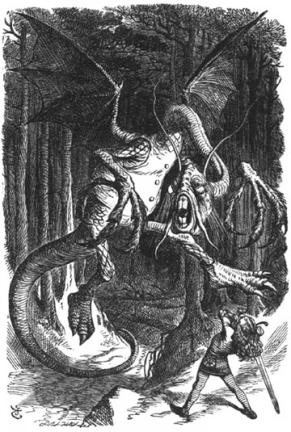
First things first: the metre. Why did Carroll choose a three-tetrameter/one-trimeter pattern? Why is the rhyme scheme ABAB? Does it mean something? Look at other nursery rhymes. Is it a recurring feature? Not exactly. The rhymes are though. Good, let’s work on that. It must rhyme. ABAB if possible.
Next thing: read-aloud qualities. This is a brilliant excuse to watch the Disney animated version. And Johnny ‘Mad Hatter’ Depp reciting fragments of it in a creepy Scottish accent. That’s how it should be. Mocking, menacing, mischievous and mildly confusing.
Ok. What to do with the actual words? Transliterate, adapt, replace, or just write some plain Italian nonsense? Hang on, wasn’t there a chapter that explained some of them..? Re-read Humpty Dumpty.
“And ‘the wabe’ is the grass plot round a sun-dial, I suppose?” said Alice, surprised at her own ingenuity.
“Of course it is. It’s called ‘wabe’, you know, because it goes a long way before it, and a long way behind it—”
“And a long way beyond it on each side”, Alice added.
(Lewis Carroll, Through the Looking Glass)
Now that is a brilliant word. Ok, I am going to do this translation following the egg-head’s directions. I’d like it to feel as though it belongs in its book.
So far I have: it must rhyme, the words must be explainable, albeit nonsensically, the sounds must be creepy at moments, soothing at others. Good. Tell you what, I’ll keep the names more or less as they are. A bit of familiarity with previous works, and some casual foreignisation. That’ll keep the academics at bay.
I think I’ve got it. The tenses are the same, the metre is there (with a couple of necessary slips), the rhymes work, not forced or clunky. And the Jabberwocky remains the Jabberwocky.
Now, for the real test: what does my eight-year-old brother think of it?
I guess I failed in my original mission. I might use this in an essay after all.
Alex Valente translates Italian and French into English, and English into Italian. He claims he also works with Old English and Latin. In the little spare time his MA in Literary Translation leaves him, he dumps some poetic reflections onto http://angolopolveroso.wordpress.com (where the Jabberwocky now resides, too). If you really feel the urge to talk to him, you can find him at alex.valente@uea.ac.uk.
Thursday, 3 November 2011
Multiple Translations of One Text
One thing people who are not familiar with the field of translation often cannot understand is how people can come up with different translations of the same source text. Surely ‘table’ means ‘table’ in any language, so why is translation so hard? Surely there’s a right and a wrong answer, and how on earth could people spend time discussing translation? Just last night, my husband – and he knows more about translation than most digital analysts, by dint of being married to me! – was exasperated to hear another of my flights of translation fancy, and blurted out: ‘You should just translate what’s there!!’
How is it, then, that if you go into Amazon and type in Madame Bovary, you can choose from Geoffrey Wall’s version, Margaret Mauldon’s version, Eleanor Marx-Aveling’s version, Lydia Davis’ version, Adam Thorpe’s hot-of-the-press version etc etc …. Indeed, in researching my Translation Theory module, I came upon a website that had 23 versions of Baudelaire’s poem Le Balcon. As I grappled with the subject – often highly philosophical, and not easy for someone who still remembers re-sitting French Philosophy in the Hall of Shame back at university – I was persuaded that the notion of ‘mind style’, an idea from the field of cognitive stylistics, might be used to explain the existence of vastly different and yet equally valid translations of a single source text.
Mind style can be defined as a linguistic style that reflects a cognitive state. Clues to the mind style of a text are to be found in its implicit information, which in turn can be worked out by looking at the stylistic devices present in a text. Stylistic devices can include such things as alliteration, ambiguity, the repetition of words, complex metaphor, or the use of different registers or of specific syntactic constructions.
I find it plausible that multiple translations of a single source text can exist because translators read the mind style of an author in different ways, influenced as they are by their own individual past experiences and worldviews. In addition to this, the translation goes through a further stage when it reaches the reader, since she or he is also going to filter the translation through her or his own experiences and worldviews.
To illustrate this point: in spring 2011, I produced a (very fine!) sample of a German novel for a literature-promoting organisation. Taken out of the context of the rest of the book, I read the German text quite positively – the scene was Rome in the summer in the 1970s, and as nothing explicitly bad happens in the short section in question, my mind was instantly transported to my own (pleasant) experiences of Rome in the summer. I gave my translation to my sister to read, who said she thought the translation adequately reflected the claustrophobia of the main character … where did claustrophobia come from, I thought? Finally, when I read my sample out at a public reading event, one of the audience’s reactions was to laugh. This is a common reaction in a group setting since it releases tension and conveys approval, but it also showed the translation going through an additional stage, that of being filtered through the mind of the reader (or, in this case, the minds of the listeners).
So the next time we pick up a translated work, we might want to remember that we’re not only getting an insight into the mind of the author, but also into the mind of the translator, and indeed into the way our own minds work, as they interact with the words on the page …
Rebekah Wilson is a freelance translator working from French, German and Dutch into English: www.oxfordtranslations.net.
How is it, then, that if you go into Amazon and type in Madame Bovary, you can choose from Geoffrey Wall’s version, Margaret Mauldon’s version, Eleanor Marx-Aveling’s version, Lydia Davis’ version, Adam Thorpe’s hot-of-the-press version etc etc …. Indeed, in researching my Translation Theory module, I came upon a website that had 23 versions of Baudelaire’s poem Le Balcon. As I grappled with the subject – often highly philosophical, and not easy for someone who still remembers re-sitting French Philosophy in the Hall of Shame back at university – I was persuaded that the notion of ‘mind style’, an idea from the field of cognitive stylistics, might be used to explain the existence of vastly different and yet equally valid translations of a single source text.
Mind style can be defined as a linguistic style that reflects a cognitive state. Clues to the mind style of a text are to be found in its implicit information, which in turn can be worked out by looking at the stylistic devices present in a text. Stylistic devices can include such things as alliteration, ambiguity, the repetition of words, complex metaphor, or the use of different registers or of specific syntactic constructions.
I find it plausible that multiple translations of a single source text can exist because translators read the mind style of an author in different ways, influenced as they are by their own individual past experiences and worldviews. In addition to this, the translation goes through a further stage when it reaches the reader, since she or he is also going to filter the translation through her or his own experiences and worldviews.
To illustrate this point: in spring 2011, I produced a (very fine!) sample of a German novel for a literature-promoting organisation. Taken out of the context of the rest of the book, I read the German text quite positively – the scene was Rome in the summer in the 1970s, and as nothing explicitly bad happens in the short section in question, my mind was instantly transported to my own (pleasant) experiences of Rome in the summer. I gave my translation to my sister to read, who said she thought the translation adequately reflected the claustrophobia of the main character … where did claustrophobia come from, I thought? Finally, when I read my sample out at a public reading event, one of the audience’s reactions was to laugh. This is a common reaction in a group setting since it releases tension and conveys approval, but it also showed the translation going through an additional stage, that of being filtered through the mind of the reader (or, in this case, the minds of the listeners).
So the next time we pick up a translated work, we might want to remember that we’re not only getting an insight into the mind of the author, but also into the mind of the translator, and indeed into the way our own minds work, as they interact with the words on the page …
Rebekah Wilson is a freelance translator working from French, German and Dutch into English: www.oxfordtranslations.net.
Thursday, 27 October 2011
Rereading Myself
We’re four weeks into the MALT programme now, and I’ve been reading all manner of fascinating books and articles, most of which have lead me to the realisation that there are a hell of a lot of ways to mess up a translation if you don’t take a very long list of things into consideration. I thought I knew how to translate, but no: my job has just got a lot more complicated. This is a terrifying yet exhilarating realisation. As an undergraduate I was taught that I must be sensitive to register, cultural specificities and tone, for example, but now I have to deal with the texts worlds and ideal readers and the wide-ranging implications of cognitive poetics. How am I supposed to know what goes on in other readers’ heads and imagine the responses that they might have to a text when I’m in Norwich and they’re in New York, for example? And how on Earth do I go about translating poetry, when so much of the meaning is between the words rather than in them? My mission, should I choose to accept it, seems to be just that.
And yet, I have to remind myself that I am still a translator (and quite a good one, I must tell myself so as not to be discouraged). I may be getting back into the murky world of theory, but my goal is still to make a career from translation. Rosalind Harvey’s workshop last week was a welcome reminder of that: she spoke about her journey from graduate working in a bookshop to literary translator and what has made the difference for her along the way, certainly made the point that taking part in the BCLT summer school should be top of our lists of priorities, and presented us with a passage to translate. This was taken from Down the Rabbit Hole, Mexican author Juan Pablo Villalobos’ brilliant first novel, which Rosalind translated and which has just been published by & Other Stories. I relished the challenge of translating the troublesomely Mexican term ‘la chingada’ into English, felt the excitement of finding what seemed to be a viable solution in that context and made a mental note to translate more, rather than get bogged down thinking about essays too much. I was encouraged by Rosalind’s advice to ‘be stubborn and friendly’ faced with the daunting task of networking (I’m with her in being horrified by the term alone) and to meet a real-life person who is has come through the MALT programme and is doing just what I hope to do: making a living from literary translation.
On that note I shall return to the books, to reading as an academic, a lover of literature, and a translator. Perhaps these readers that coexist in me could get together and discuss where exactly it is that they overlap, then let me know their findings?
Lucy Greaves translates from Spanish, French and Portuguese into English. She is currently studying the MA in Literary Translation at UEA, and is particularly interested in Latin American literature. Contact: lucygreaves@gmail.com.
And yet, I have to remind myself that I am still a translator (and quite a good one, I must tell myself so as not to be discouraged). I may be getting back into the murky world of theory, but my goal is still to make a career from translation. Rosalind Harvey’s workshop last week was a welcome reminder of that: she spoke about her journey from graduate working in a bookshop to literary translator and what has made the difference for her along the way, certainly made the point that taking part in the BCLT summer school should be top of our lists of priorities, and presented us with a passage to translate. This was taken from Down the Rabbit Hole, Mexican author Juan Pablo Villalobos’ brilliant first novel, which Rosalind translated and which has just been published by & Other Stories. I relished the challenge of translating the troublesomely Mexican term ‘la chingada’ into English, felt the excitement of finding what seemed to be a viable solution in that context and made a mental note to translate more, rather than get bogged down thinking about essays too much. I was encouraged by Rosalind’s advice to ‘be stubborn and friendly’ faced with the daunting task of networking (I’m with her in being horrified by the term alone) and to meet a real-life person who is has come through the MALT programme and is doing just what I hope to do: making a living from literary translation.
On that note I shall return to the books, to reading as an academic, a lover of literature, and a translator. Perhaps these readers that coexist in me could get together and discuss where exactly it is that they overlap, then let me know their findings?
Lucy Greaves translates from Spanish, French and Portuguese into English. She is currently studying the MA in Literary Translation at UEA, and is particularly interested in Latin American literature. Contact: lucygreaves@gmail.com.
Thursday, 20 October 2011
More International Fiction Reading Group
B.J. Epstein, who teaches in the MALT programme, helps to run an international fiction reading group at the Norwich Library. It meets once a month, on the second Wednesday of the month at 1.30 – 2.30 pm.
The next meeting is on 9 November and we will be reading Banana Yoshimoto’s Kitchen.
Everyone is welcome.
The next meeting is on 9 November and we will be reading Banana Yoshimoto’s Kitchen.
Everyone is welcome.
Thursday, 25 August 2011
International Fiction Reading Group
B.J. Epstein, who teaches in the MALT programme, helps to run an international fiction reading group at the Norwich Library. It meets once a month, on the second Wednesday of the month at 1.30 – 2.30 pm. The group is relaunching for the new academic year on 12 October. Everyone is welcome.
You can read more about it on the library’s blog.
You can read more about it on the library’s blog.
Friday, 19 August 2011
Is the author dead or alive?
The translator’s job is a lonely one, just as the writer’s. You are alone with the words. Yes, of course, there will be times when the translator will be stuck and will look for help, but usually such help comes from research, a friend or a native speaker that may clarify something that might be unclear for the translator. At least that is what I always thought about translation. I never expected that any substantial help can some from another person, let alone from the writer. That is why my answer to the title question has always been: DEAD.
After all, even if the author is actually alive, you can’t always expect her/him to be open to questions and willing to help. From the beginning of the MA we have been hearing stories about authors refusing to collaborate with translators. One example is J.K. Rowling who gave no instructions to translators even though it was certain that the translations would reach large audiences. Then, there are authors who are willing to help but simply cannot due to language limitations or because a part of the creative process just cannot be explained, so no matter how much they want to help the translator they cannot. Finally, there are the ones who are eager to help but perhaps are too eager and have overestimated themselves thinking that they know best no matter their target language proficiency. So again, all things considered, my answer remained: DEAD. I really saw no reason why a translator would want to complicate her/his life by contacting the author. And then, when I started working on my own translations again the answer was the same because I chose to translate work by Cavafy, Leivaditis, Bishop, Kariotakis and Gogou, all of them indeed dead.
But then, for an essay I decided to include my translations of some poems by a poet who is alive and kicking and though I was not particularly stuck or anything, I had access to his email address and thought I’d use it. So, I sent an email saying who I was and what I was doing. The reply came soon and read ‘Of course, ask me questions’. It was unexpected in a very pleasant way. The answers to my questions took some time to come, but they meant I could fully support my choices and even quote the original author in my essay. The poet had his doubts about the poems I had chosen and was not sure I was going to be able to render them in English but in the end, the feedback I got for my translations from my tutors suggested that contacting the author had helped the quality of my work. So, perhaps, I thought after that, the author is not-always-dead?
And finally, the summer came which, for MALT-students means one thing; dissertation period and again, I decided to translate an author that is alive and kicking. Again, I was able to get the author’s email address and thought there was nothing to lose, I could use it. And I did. Again, the reply came very soon and was very friendly and encouraging. I went on to send a long email with many questions and the author got back to me giving me answers and –perhaps more importantly- giving me freedom and telling me not to worry too much about translating the original names and puns as such, but to be creative instead. What works in one language does not necessarily work in another. He also offered to look at my translations –he is very fluent in English and has been living in the UK since the early 1970’s- but kept stressing to me that I should not worry too much and should be creative, always politely answering any questions I had.
The above experiences have helped me reach one conclusion in the search of an answer to the title question, that is that the translator should try to see whether the author is alive or dead because there is no fixed answer. Sometimes the author is alive and kicking, but, kicking you away and thus, should be considered dead, and others the author is there to make the translator’s job just a little bit easier.
Avgi Daferera is a translator of English and Spanish into Greek, and Greek and Spanish into English. She just finished an MA in Writing at Warwick and is currently doing an MA in literary translation at UEA. She is interested in the translation of poetry and children’s fiction.
Contact: daferera.avgi@gmail.com
After all, even if the author is actually alive, you can’t always expect her/him to be open to questions and willing to help. From the beginning of the MA we have been hearing stories about authors refusing to collaborate with translators. One example is J.K. Rowling who gave no instructions to translators even though it was certain that the translations would reach large audiences. Then, there are authors who are willing to help but simply cannot due to language limitations or because a part of the creative process just cannot be explained, so no matter how much they want to help the translator they cannot. Finally, there are the ones who are eager to help but perhaps are too eager and have overestimated themselves thinking that they know best no matter their target language proficiency. So again, all things considered, my answer remained: DEAD. I really saw no reason why a translator would want to complicate her/his life by contacting the author. And then, when I started working on my own translations again the answer was the same because I chose to translate work by Cavafy, Leivaditis, Bishop, Kariotakis and Gogou, all of them indeed dead.
But then, for an essay I decided to include my translations of some poems by a poet who is alive and kicking and though I was not particularly stuck or anything, I had access to his email address and thought I’d use it. So, I sent an email saying who I was and what I was doing. The reply came soon and read ‘Of course, ask me questions’. It was unexpected in a very pleasant way. The answers to my questions took some time to come, but they meant I could fully support my choices and even quote the original author in my essay. The poet had his doubts about the poems I had chosen and was not sure I was going to be able to render them in English but in the end, the feedback I got for my translations from my tutors suggested that contacting the author had helped the quality of my work. So, perhaps, I thought after that, the author is not-always-dead?
And finally, the summer came which, for MALT-students means one thing; dissertation period and again, I decided to translate an author that is alive and kicking. Again, I was able to get the author’s email address and thought there was nothing to lose, I could use it. And I did. Again, the reply came very soon and was very friendly and encouraging. I went on to send a long email with many questions and the author got back to me giving me answers and –perhaps more importantly- giving me freedom and telling me not to worry too much about translating the original names and puns as such, but to be creative instead. What works in one language does not necessarily work in another. He also offered to look at my translations –he is very fluent in English and has been living in the UK since the early 1970’s- but kept stressing to me that I should not worry too much and should be creative, always politely answering any questions I had.
The above experiences have helped me reach one conclusion in the search of an answer to the title question, that is that the translator should try to see whether the author is alive or dead because there is no fixed answer. Sometimes the author is alive and kicking, but, kicking you away and thus, should be considered dead, and others the author is there to make the translator’s job just a little bit easier.
Avgi Daferera is a translator of English and Spanish into Greek, and Greek and Spanish into English. She just finished an MA in Writing at Warwick and is currently doing an MA in literary translation at UEA. She is interested in the translation of poetry and children’s fiction.
Contact: daferera.avgi@gmail.com
Subscribe to:
Posts (Atom)