Showing posts with label children's literature. Show all posts

Wednesday, 20 August 2014

Defining the Role of the Translator: my year on the MA in Literary Translation

Looking back at my work from the MA in Literary Translation, it has been the role of the reader and of the author that has continued to shape my idea of what it means to translate. To what extent is an author responsible for their work? And how does this influence the process of translation? To what extent is any reading of a text possible? And how does this affect my role as a translator? These are the ideas which have and continue to excite me.
During the first semester I focused on the translation of landscape within Anton Chekhov’s short stories. Through this work I discovered that a text, in itself, creates the potential for profound effects on the reader, something which I argue is similar to standing in a landscape; the topography, colours and situation all create a potential to illicit certain responses from the reader. My main focus therefore remained on the text itself, in considering, as Umberto Eco puts it, its ‘maze-like structure’, and therefore my aim as a translator was to recreate this particular structure in order to retain the same potential for effects.
During the second semester I translated a children’s story that was written in Russia during the Stalinist period. I found the translation of this particular children’s story to be extremely complex, as the role of the reader (a child) and of the author (someone bound by law to write for the purposes of communism) were closely bound by an ideology that differed drastically from the prevailing ideology of the culture into which I was translating the text; my focus was consequently shifted to the reader, making sure that the subversive elements, already present in the text, were visible in the translation. During this semester I also translated a selection of microfiction by the Russian writer Daniil Kharms. I began the project by reading the author’s notebooks alongside his microfiction, but soon discovered that the voices within these texts were indistinguishable; the voice in the notebooks was no closer to Daniil Kharms, as a once real, living person, than the voice in his microfiction. This project transformed the way in which I approach translation, decentring the role of the author, and thereby freeing up my role as a translator; emphasis was on the text, and my reading of it.
Finally, my last project on this course focuses on the translation of three short stories by the Russian writer Tatyana Tolstaya, and in particular on the notion of ‘mind style’; a notion which suggests that systematic linguistic choices reflect the workings of an individual mind. Through this research I have come to understand the author within the text is a hazy spectral figure created through concrete elements of the text, something neither completely dead nor completely alive; something which has the ability to shift and change, but which nevertheless has a felt presence, allowing the text to work as an organic whole. I have so far concluded that because a work of literature is both a concrete text which has been organised by an individual mind, and because it requires a reading in order for it to have any meaning, a translation is always inevitably both an individual reading and a recreation of the work as constructed by an author; a translator, in other words, is always to a greater or lesser degree, a collaborator; neither working alone, nor at the mercy of authorial intention.

Hannah Collins studied Russian and French at the University of Nottingham. She works as a freelance translator and is currently studying on the Literary Translation MA at the UEA. Her email address is Hannah.Collins@uea.ac.uk.

Thursday, 10 April 2014

Translating Arkady Gaidar’s The Blue Cup: the complex nature of children’s literature


For the past few weeks, I have been absorbed in the translation of children’s literature. Before looking into this area of translation, I wouldn’t necessarily have expected it to be easy to translate children’s literature, as any literary text will pose its own particular set of problems, but I certainly hadn’t expected it to be one of the most challenging and complicated areas of translation.  

First of all, defining what does and doesn’t constitute children’s literature is problematic; should we define it as literature that has been written for children? Or as works of literature that children choose to read for themselves? What is a child? Can we come to a complete definition of a child, and therefore firmly conclude what children’s requirements are with regards to literature? Furthermore, when we translate cross-culturally, what may be considered appropriate for children in one culture may not be considered appropriate for children in another, how can translators deal with such instances, while avoiding the manipulation of their readers?

I have been working on a translation of The Blue Cup by Arkady Gaidar, a children’s story written in Soviet Russia.  Many aspects of the text have been heavily influenced by the Socialist Realist doctrine of the time; it presents the reader with idealisations of work, industrialization, the Russian countryside and of the Red Army, for example, and some could consider such a text unworthy of translation into English for Western children, as the underlying ideology of such a text is not fully convergent with the ideology of Western culture, and may therefore be considered harmful and manipulative.

However, what prompted me to translate this particular text is its fragmentary nature; despite being heavily influenced by the ideology of its time, this text is predominantly subversive and, I would therefore argue, valuable for children. The Blue Cup is a story about a Russian family (a mother, father and daughter) on holiday at a cabin in the countryside. The mother takes to nagging the father and daughter (Svetlana) about all kinds of chores, not allowing them to play and enjoy themselves whilst on holiday.  The final straw comes when she accuses them of breaking her blue cup and in an act of defiance they decide to leave for an adventure across the Russian countryside. It is through Svetlana and her father’s close relationship that this text comes to be subversive, as the father introduces Svetlana to the emotional complexities of the adult world; through allowing his daughter to come into contact with a variety of people and discussing issues such as war and anti-Semitism, and by confiding in her his doubts with regards to the mother’s love for him. Furthermore, and most importantly, in their defiance of the mother, the father teaches Svetlana to challenge over-bearing authority.  In these instances I therefore paid particular attention to the nuances of the language used by Svetlana and her father when addressing each other.

It was extremely difficult to decide how to deal with aspects of the text that were conventional for its time, as children would not be aware of the socio-historical context and could consequently be open to manipulation; I had therefore considered changing or even removing some aspects of the text. However, I have come to the conclusion that it would be short-sighted to alter or remove these aspects. Precisely because Western children will lack the socio-historical context that would allow these images to be understood as part of a certain ideology, these idealisations will be no more harmful than the idealisations of work and the British countryside in children’s stories such as Thomas the Tank Engine or Postman Pat. Furthermore the underlying ideology will not be consistently supported by surrounding discourse; and therefore these depictions will do little more than allow children to come into contact with ‘the foreign’, displacing them for a short time from their own culture. I have come to believe that translating a variety of children’s literature is therefore necessary and vital to encourage a multiplicity of world views within children, and not to simply limit them to the confines of their own.


Hannah Collins studied Russian and French at the University of Nottingham. She works as a freelance translator and is currently studying on the Literary Translation MA at the UEA. Her email address is Hannah.Collins@uea.ac.uk.
Tuesday, 28 January 2014

Che gelida manina! – baby-talk in translating Where the Wild Things Are

It’s a Saturday night and I have decided to translate Where the Wild Things Are. Sometimes people debate on which books can be considered classics in children’s literature, but about Sendak’s masterpiece there’s absolutely no doubt. And this is the reason why I wanted to translate it on the first place. It’s no secret that I aspire to combine translation with my other great ambition to become a writer, and translating classics for children is my starting point.

What interests me the most are not only the reasons why some children’s books become classics (oh, the list is long…) but also the way authors use words and language. I have a passion for words that words alone cannot describe. Let me put it this way. You know the old ice-breaking game “what would you bring with you to a desert island?”… I would bring a dictionary. Preferably one with synonyms, etymology and collocations. I am mad for words. Give me neologisms to translate, and I will be the happiest translator on Earth.

I approached my first draft of Là dove stanno le cose selvagge with certain boldness. While I was working on it, I had that feeling only translators know: this is the right direction. I was happy with many of the choices I made, every sentence seemed to fit like a glove, but. But.

At some point, I realised that there was something that sounded wrong, almost out of key. I read and re-read my translation, looking for unconvincing verb tenses, superfluous possessives, well-conceived grammatical discrepancies. What was it? What is it that sounds so wrong?

Ohhh. Got it.

The wild things roared their terrible roars and gnashed their terrible teeth

and rolled their terrible eyes and showed their terrible claws

but Max stepped into his private boat and waved good-bye […]


Le cose selvagge ruggirono terribilmente e digrignarono i terribili denti,

e spalancarono i terribili occhi e mostrarono i terribili artigli,

ma Max salì sulla sua barca e fece ciao con la manina […]


Here’s a gloss of the last sentence, where the off-key note is.


ma Max  salì   sulla  sua  barca  e    fece  ciao  con  la   manina […]

but   Max  stepped  on-the  his     boat    and    did      bye    with   the   little-hand DIM.


La manina. The little hand. It’s back.

Don’t get me wrong, I love diminutives and all kinds of alterations. But I have become very sensitive to using them when addressing to children since I have worked for the British Council in Milan as young learners’ assistant. One of my duties was to walk my caterpillars (pre-primary school children) to the toilet during classes, and one day it happened that I asked one of them to give me their manina (little-hand). My supervisor had heard me and she kindly urged me not to use diminutives with children. After all, what from our point of view is a cute little child hand, from their point of view is… just their hand. Proportions, uh?

I had forgotten about this, but then the manina came back in my translation of Where the Wild Things Are. I did a little bit of research on the topic, and I found that the debate on what expert call “baby-talk” is lively. On one side, “baby-talk” seems to be encouraged because it bonds a strong relationship between parents and children (it is also called parentese), and because it also contributes to children’s mental development; on the other, it is strongly criticised for giving the child a limited repertoire of words, and therefore can inhibit the child’s speech development.

What should the translator do?

Personally, I’ve decided to put away the little hand. Partly because my supervisor’s argument seemed strong enough to me. Then I also thought: what if by using diminutives we contribute to build a wrong child image in children’s literature? How would an Italian child describe Max’s hand? And even if s/he said manina, how can we be sure that s/he has not been influenced by the baby-talk employed by adults that surround him?

I have no answers for these questions, not at the moment. Anyway, I don’t think I’m wrong when I say that Where the Wild Things Are is a book to be read aloud by parents to their child, and if they really want to say manina instead of mano, certainly I won’t be the one preventing them from doing that!


See also:

How can child-directed speech facilitate the acquisition of morphology?, by Vera Kempe, Patricia J. Brooks, and Laura Pirott. 2001. Research on Child Language Acquisition: Proceedings of the 8th Conference of the International Association for the Study of Child Language. 1234-1244)    

---

My name is Elena Traina, I graduated in Lingue e Letterature Straniere at the Università degli Studi di Milano, now I’m studying Literary Translation at the University of East Anglia. I translate from English and Spanish into Italian. My main literary interest is children’s literature, but I also like to write and translate poetry and short fiction. I can be reached at elena.traina39@gmail.com.

If you are interested in the MA in Literary Translation, or would like to study at UEA, I also recommend that you take a look at my Italian blog: http://www.elenainuk.blogspot.it

Thursday, 2 May 2013

Chinese Children's Literature


China has lots of stories. There are all sorts of fantastic tales, about monsters, warriors, ghosts and heroes. It's got the one about the naughty Monkey, who goes on a great journey and fights all the time. It's got the one about the cowherd who falls in love with a goddess. There's a festival in China that celebrates their love. There's the one about a lady who lives forever on the moon, with a rabbit and a lumberjack who can't chop down the cinnamon tree. The stories capture the imagination of children across China.  I remember wanting to read about them when I was at school. But these are old stories. They're really more like folk-tales. You can read them in English, some I did, but they aren't so much translated into English as being written as an English 'version'. There are lots of new ones in China that are popular with children too, but what I want to know is whether or not they can be read in English. Can they excite children who read English in the same way?


Over the last few months I have been investigating translated children's literature from mainland China. It hasn't been easy. I know that there is a lot of it in mainland China; the four classics (三国演义-San Guo Yan Yi,水浒传-Shui Hu Zhuan,西游记-Xi You Ji,红楼梦-Hong Lou Meng) all have numerous children's versions and picture books, readily available in book shops, supermarkets and street markets. Writers such as  Bing Xin, Zhang Tianyi, Sun Youjun, Sheng Ye, Zheng Yuanjie, Zhou Rui and many more besides are familiar names in China as children's literature writers. There is also a wealth of online Chinese literature aimed at young adults; if you look them up on book.kanunu.org you will find they are added regularly, and there are plenty of sites that you can find through Baidu (百度一下您就知道). The problem is – an this could be because I haven't looked in the right place – that I can't find much of it in English translation (I think only Sun Youjian has some of his works translated and published that you can find on Amazon...).


One  children's story that I have found from mainland China and translated into English is in a collection of Ye Shengtao's works. It's perhaps pertinent to note that Ye is  one of the founders of children's literature in China, or 童话-tonghua, which up until the 1920s did not exist. Children read literature before this, of course, but they read the same literature as adults. Tonghua came about when China was trying to adapt to new ideas from foreign countries. The notion that children were different from, and had different needs to, adults was one of these ideas (for more on this see Dr Ho Laino's essay 'Children's Literature -Then and Now, 1997). This idea seems to have stuck, as there are lots of stories and books published in China, in Chinese, with children in mind. But what I want to know is why does it seem like hardly any of it, if any at all, has been translated for children in English?


I've been looking to the translation of Ye's '稻草人’ - Dao Cao Ren – to find out more, as it is arguably his most famous children's story. The translation by Ying Yishi was published in 1987. I've got to admit, the story is an odd one for a children's story, and I'm not sure it's the most likeable one I've ever read. I don't think that as a child (spoiler alert) that I'd like to have read about a girl who gets sold by her alcoholic father and commits suicide, and about a sweet old lady whose husband and son have died tragically, who's lost her money and whose crops are destroyed. Even the helpful scarecrow of the story can do nothing, and in despair drops down in the dirt of the field. It's a bleak tale, and the translation doesn't sugar-coat it.


But the translation is interesting. It captures the tone of the original, that of a children's tale, very well. The issue that I have with it is that it was put into a collection with Ye's adult literature – How Mr Pan Weathered the Storm. Its publication like this suggests to me that the translation was more about preserving Chinese 'Literature' in English than about translating a Chinese children's story for children to read. The translation also omits a religious reference from the original, which is perhaps politically motivated, and the scarecrow talks of how he wants to cook up something nutritious, which is translated in a way that would not sound very delicious to a child in English (grub guts and gruel anyone?). I get the impression that although the original was written with children in mind at the time, its translation in 1987 did not share this aim.


Because of its  content, it seems like an odd story to translate for children. But why is it one of the only Chinese children's stories in English translation? Julia Lovell, in her article last February for Prospect magazine, noted that anglophone publishers were generally only interested in publishing something which incites controversy -'either sex or politics; and ideally both'. It could be that these publishers think this way because it is what readers want; sex and politics. I've been exploring translating children's literature in terms of Gideon Toury's norms theory, and perhaps such desires are the stronger literary norms in anglophone cultures.  Maybe chinese literature, and even more so for its sub-genres, is marginalised in English. If this is the case, then I see very little hope for literature which is both 'Chinese' and 'children's literature' being translated into English and published.


I am, however, willing to think otherwise. There might be a cornicopia of children's literature translated into English out there, and perhaps I just haven't come across it yet. If so, I would love to hear about it and I would love to read some of it. I hope that there is lots out there, and that there is lots more on the way. The sheer size of the country suggests that China has all sorts of interesting people with interesting things to say, and with all sorts of interesting ways of saying them. I know that China has lots of stories to tell, and lots of children's stories that can capture the imagination, and I want to read more of them.


Thomas Newell translates from Chinese into English, and is currently a studying for an MA in Literary Translation at the UEA as well as an interning for Arc Publications. Contact thomashenrynewell@gmail.com

Thursday, 25 April 2013

‘Foreign lands’ in translations for children


Up into the cherry tree
Who should climb but little me?
I held the trunk with both my hands
And looked abroad on foreign lands.
(Robert Louis Stevenson)

Before studying it on the MA in Literary Translation, I hadn’t really given much thought to the issue of translating for children. Which is strange, perhaps, given that one of the stories I loved most as a child was a translated one: Erich Kästner’s Emil and the Detectives (also a favourite of the writer Michael Rosen, who is due to give a talk on the book at the Brighton Festival in May.)

The fact that Emil and the Detectives had been translated from German really didn’t matter to me when I read it as a child. What I was interested in were the characters, and the twists and turns of the plot. I certainly don’t remember being put off by what was ‘foreign’ in the story. The question of foreignness in a translated text and how it impacts upon young readers is one I find fascinating, having now explored some of the issues surrounding children’s literature and translating for young readers in more depth.

Do children dislike foreignness in texts, tolerate it, or positively relish it? And is that even a valid question to ask, since it lumps all children together under one umbrella? Children’s reading tastes vary enormously, just as adults’ do; some young readers are more willing to tolerate uncertainty than others, some love strange names or made-up words, some like fantasy and some like football stories. Factors such as age, gender and reading confidence may well come into play here, and a translator needs to bear these in mind when thinking about the target audience for any given translation. But even an individual child’s reading tastes can vary from week to week or from book to book. We should not assume we can always predict what children will enjoy or want to persevere with. Author Gillian Avery celebrates ‘the encouraging thought that you never know what [a child] is going to make of the material with which you confront him’ (1976:33).

Translators for children need to be careful, then, not to jump to conclusions about which elements of a source text their target audience will be interested in or able to cope with. This includes elements specific to the source language or culture – such as names of people or places or historical or literary allusions – that could potentially be unfamiliar to young readers in the target culture (what Ritva Leppihalme refers to as ‘culture bumps’, 1997). When I translated part of a German children’s book called Jette (aimed at readers of twelve and over) I came across several culture-bound elements which I felt might pose a problem for English-speaking readers of my translation.

Names of people and places didn’t actually fall into this category – I retained most of the characters’ original German names unaltered in my translation, knowing that children ‘can and do take delight in the sound and shape of unfamiliar names’ (Lathey, 2006:7). I did adapt the spelling of a couple of names – for instance, I changed the protagonist’s name, Jette (pronounced ‘yetter’), to Etta – but I only adopted this strategy when I felt that the spelling of the German name would cause major pronunciation difficulties in English.

However, when it came to some of the other culture-specific aspects of the text, I felt that a little more intervention was needed. The historical references found at several points in the book were a case in point. The extract I translated contained references to Hitler, the fall of the Berlin Wall, and the ‘Ossis and Wessis’ (nicknames referring to the citizens of East and West Germany in the era of the Iron Curtain). I was determined not to delete the references altogether, even though I knew they would quite possibly prove challenging for English-speaking child readers. My feeling was that part of the value of translating this particular book was surely to give English-speaking children an insight into Germany past and present. Göte Klingberg maintains that ‘one of the aims of translating children’s books must be to further the international outlook and the international understanding of young readers’ (1978:86). While I don’t think that this necessarily holds true for every translation, I felt that in this instance the historical references were so central to the text and to an understanding of Germany that it wouldn’t be appropriate to remove them.

Equally, though, if I’d retained them in translation exactly as they were I would have been failing to acknowledge an important fact: that the historical events in question are unlikely to be as familiar to UK children as to German children. I therefore decided to make some additions which would to help explain the references, and make them more accessible to my young target audience. At the same time, I didn’t want to turn an exciting story into a history lesson. I needed to work the explanations into the narrative unobtrusively. It is perfectly possible to do this in translation: Gillian Lathey notes that ‘[a] neatly disguised insertion conveys the necessary culture-specific information without jarring the narrative or alienating the young reader’ (2010:179). I inserted extra information ‘disguised’ as dialogue and free indirect discourse, in the hope that this would prevent the translation sounding too didactic while still helping readers to understand the cultural allusions.

Van Coillie and Verschueren point out that today ‘more and more translators, out of respect for the original text and because they want to bring children into contact with other cultures, choose to retain a degree of ‘foreignness’ in their translations’ (2006: viii). To me this shows an encouraging faith in children’s ability to tackle what is new and unfamiliar. Yes, ‘foreignness’ in a text may present a challenge – but it may also appeal to children’s curiosity, fire their imaginations, enable them (to borrow Robert Louis Stevenson’s words) to ‘look abroad on foreign lands’. And that is an opportunity I don’t think we should deny them.


Romy Fursland translates from German and French into English. She is studying for the MA in Literary Translation at UEA and is currently translating a selection of contemporary German poetry for the Translating ‘Live’ Poetry project organised by UCL and Poet In The City (www.ucl.ac.uk/spanishlatinamerican/news_events/repository/translating-live-poetry).


References

Avery, G.  in Fox et al (eds) Writers, Critics and Children, 1976

Leppihalme, R. Culture Bumps: An Empirical Approach to the Translation of Allusions, 1997

Lathey, G.  The Translation of Children’s Literature: a Reader, 2006

---- The Role of Translators in Children’s Literature: Invisible Storytellers, 2010

Klingberg, G. in Klingberg et al (eds) Children’s Books in Translation: The Situation and the Problems, 1978

Van Coillie, J. and Verschueren, W. Children’s Literature in Translation: Challenges and Strategies, 2006

Thursday, 18 April 2013

“What if ‘adapted from’ in literature could also mean ‘translated from’?”


I would like to write about the experience I had working on the essay for the module Process and Product. When I started the MA in literary translation, I had a fixed idea on what was a translation and what was not. In my naïve opinion, translations had to be perfect mirroring reproductions of the source text and it was not the translator’s job to include her or his subjectivity. After spending two semesters working on translations, I slowly realised that the perfect translation was impossible. The awareness of this impossibility became the liberating factor that allowed me to call my children’s short story adaptation of Jacques Attali’s book, A brief history of the future a translation. Why? Because it was apparent to me that the process of my adaptation was identical to the process of any other translation. Even though the target text was far more creative than any target text I had ever done, I have never written a more meaningful and purposeful translation.

Attali is a French economist and author, he wrote in this book, published in2006, about the next fifty years of the planet. He explains basically what will happen according to him, what plausible future our behaviour is leading to. But he also makes clear that there is no way to know for sure what is awaiting us but he writes: ‘Finally, I want to believe that the horror of the future predicted here will contribute to make it impossible.’ (personal translation from Attali 2006: 391) In my researches I discovered that three French men have written a series of graphic novels adaptation for adults from Attali’s book. They created a whole story line with plot and characters but it is all based on the future Attali describes. Somehow, this very economical, political book had become very accessible even enjoyable and Attali’s words had spread. When I read the book with the intention of translating it, it seemed evident to me that I wished to translate it for children and therefore I would have to make it accessible to them.

What better audience than children? They will be the first affected with what will happen and yet they are so hard to address to with such complex issues. However, Jean Boase-Beier and Michael Holman (1998: 17) wrote in The Practices of Literary Translation: Constraints and Creativity that ‘the constraints imposed by the presence of a source text empower and enhance the creativity of the translation act by placing the translator in a position of striving to overcome them.’ For this challenging translation, I had to produce a voice and a story that would be enjoyable and relevant for readers between the ages of 11 and 13 and to keep real traces of Jacques Attali’s work. So I created the story of Amy a 12-year-old living in 2073 on what is left of England who finds in her granddad’s study a mysterious paper diary. This discovery leads to a conversation between the little girl and her grandfather about his life and the adventures he had as a transhuman (Attali’s concept of an altruism movement which will help the world to survive what he calls the ‘hyperempire’ and ‘hyperconflict’). Papy, the granddad was born in 2001, which is approximately the year of birth of the readers, so there is a double connexion between the readers and both characters. I had to explain, with accessible words, concepts and ideas from the source text. Papy’s character was very useful as he allowed me to employ words and structures of sentences that 12 year old would not say but would understand. He was definitely a bridge between the source text and the target readers.

In this exercise, maximal relevance was required, as Boase-Beier defines it, ‘Maximal relevance, when applied to the reading of a literary text, suggests that the way the text is formulated will be seen by the reader as especially significant.’ (2006: 49)  Even though relevance was a challenge, I also had constraints from the source text and the author’s intentions, as well as having to take into account my target readers’ background and expectations. All the difficulties encountered in the process of this piece of work made me view literary adaptations as translations more than ever before.

Charlotte Laruelle translates from English into French, currently doing the MA in literary translation at UEA. Contact: charlotte.bdf@hotmail.fr


Thursday, 11 April 2013

Suitable for ages 3 to 103: when children’s books aren’t just for children


I love Winnie the Pooh. There, my secret’s out. I even have two pairs of Winnie the Pooh pyjamas (though on second thoughts, maybe I should keep that one to myself). A. A. Milne’s tales of a bear and his forest companions were a big part of my childhood and when I recently settled down for a nostalgic return to One Hundred Acre Wood (please don’t judge, it’s a stressful term), I realised that Winnie the Pooh and The House at Pooh Corner are books for adults too.  It’s actually quite common in Britain for writers to create children’s books with dual addressivity (think Alice in Wonderland or The Hobbit). The humour of Winnie the Pooh is specifically aimed at adults as well as children. In fact Winnie the Pooh has a cult status among many young adults (I’m not alone!) and is one of Britain’s best loved children’s books. Emer O’Sullivan wrote an article for New Comparison in 1993 explaining that the book’s charm comes from representing ‘a utopia’, ‘a safe world in which the main occupations are eating, exploration and visiting friends’ (1993: 114). Furthermore, A. A. Milne pokes fun at real life by parodying it through animals.

What O’Sullivan’s article then goes on to examine is of crucial importance for translation: how do you keep this duality in translation? Especially if the target culture does not have a tradition of writing children’s books aimed at anyone apart from children (although how one defines a child and at what age childhood ends is a whole other kettle of fish). O’Sullivan concentrates on the translations of these books into German which have completely ignored the dual element of the texts and aimed them only at children. She says that the first German edition which was published in 1928 and translated by Edith Lotte Schiffer ‘was never more than a moderately successful children’s book [...] it seems reasonable to claim that the comparative lack of status of this translation is a consequence of the way in which aspects which appeal and are addressed to adult readers were translated into German’ (2005: 116). For example, instead of being bitter and sarcastic, Eeyore is reduced to a sad, moaning creature (1993: 117-118).

On the other hand, the Spanish translation by Isabel Gortazar from 2000 seems to have tried to maintain these elements, aiming to make adults laugh as much as children.  When Pooh and his friends go on an ‘expotition’ (Pooh’s word) to find the North Pole, Eeyore says in typically sarcastic fashion, ‘we can look for the North Pole or we can play ‘’Here we go gathering Nuts and May’’ with the end part of an ant’s nest. It’s all the same to me.’ The Spanish version has ‘por mí, podemos ir a descubrir el Polo Norte o dedicarnos a jugar a policies y ladrones. Me da exactamente igual.’ (We could go to find the North Pole or we could play policies and robbers. It’s all the same to me). In the original Eeyore compares going to the North Pole with the idea of playing ‘gathering nuts and may’. But he subtly equates the trip with an absurd version of the game using the ant’s nest. The Spanish makes a play on the game cops and robbers by using ‘polices’ which means nothing in Spanish but is close to policía (police) and obviously looks like a funny plural form of the English ‘police’ which is incorrect. Eeyore remains highly ironic throughout the translation. At a party held for Pooh Bear, Eeyore gets the wrong end of the stick and thinks it’s his party. Upon discovering that he is wrong he says: ‘‘After all, one can’t complain. I have my friends. Somebody spoke to me only yesterday. And was it last week or the week before that Rabbit bumped into me and said ‘’Bother!’’ The Social Round. Always something going on.’’ In Spanish he says: ‘’Después de todo, no sé de qué me quejo. Tengo amigos. Ayer mismo alguien me dirigió la palabra. Y no hace ni una semana que Conejo chocó conmigo y dijo, ‘¡Canastos!’ Una intensa vida social." (After everything, I can’t complain. I have friends. Yesterday someone spoke to me. And not even a week ago Rabbit bumped into me and said ‘Oh gosh!’ Such an intense social life).  It’s clear that Eeyore’s humorous pessimism is alive and well in Spanish.

Generally speaking adults are the ones who buy children’s books and they may well read them aloud to their children, while some may be uncomfortable with the power of adults over the world of children’s literature (they write the book, translate it, publish it and review it) it is undeniable that for a children’s book to garner success it must appeal to adults in some way. Another reason why it is so important to keep any dual addressivity is because it raises the status of the subsystem children’s literature within the wider literary polysystem. Children’s literature is woefully overlooked in translation, especially anything more than picture books and so getting adults involved is a key strategy.  When translators efface certain elements of the source text they’re stamping the text with what Riita Oittinen calls their child image – the ideal child, based on their own childhood and children today, who they have in mind when they write the book. However, some translators of children’s literature need to think about their adult image too. There’s more to consider than the child tucked up in bed waiting for their bedtime story, as translators we can’t forget the adult charged with reading it aloud. When I have children they’ll be hearing Winnie the Pooh whether they like it or not!

For more information see:

O’Sullivan, Emer. (1993), ‘The Fate of the Dual Addressee in the Translation of Children’s Literature’ in New Comparison, no. 16, pp. 109-119.

O'Sullivan, Emer. (2005), Comparative Children's Literature. London and New York: Routledge.

 
Emily Rose translates from French and Spanish into English and is currently doing an internship with the BCLT. Contact her here: emilylindarose@gmail.com.

Wednesday, 9 January 2013

What is equivalence for children?


I never thought before starting the MA in literary translation about translation so much. It literally invaded my life! I cannot read a book or the newspaper, watch a film or tell a story from France without thinking about domestication, adequacy or equivalence. I cannot help myself thinking: ‘This does not work.’… ‘They did that well.’… ‘What would be the best way to translate this?’ or ‘What theory is behind that?’ And I realised that translation theories could be applied not only to literary translation but also to every communicational instruments. That realization stroked me, when I thought about people in France who spend their lives surrounded by translation results; about one book published out of six is a translation and most of the films, programs and adverts of television are dubbed, but they do not really think about it or realise it. I personally think that being able to translate is opening a door on a new writer, a new story, a new style to another culture and other people.

I would like to discuss a translation I have done myself for the MA. The book I translated into French was the children’s book The very hungry caterpillar by Eric Carle. I came across several issues with this translation. What theory should I work with? Children’s literature is different from the rest of literature; it is addressed to a very specific audience, with particular needs. Children do not care in what language and what culture the book is from, so I decided to go for a translation following the principal of dynamic equivalence. As Eugene Nida explained in his essay ‘Principles of correspondence’, ‘the relationship between receptor and message should be substantially the same as that which existed between the original receptor and the message.’ The story must seem as natural for the readers of the target text as it is for the readers of the source text.

So my first issue was the fact that the caterpillar in the original version is a male caterpillar that becomes a butterfly. The problem was that in French noun have an already predetermine gender and in that case, caterpillar in French is feminine ‘une chenille’ and a butterfly is masculine ‘ un papillon’. I remembered as a kid making the association between the gender of the signifier and the representation I was making of the signified, so ‘une chenille’ in my head was a girl, and ‘un papillon’ was a boy. Because the butterfly is used only once in the whole book and the story is actually about the caterpillar, I decided to change the original male caterpillar into a female caterpillar. I thought it would be more relevant or familiar for children.

The second concern I had was with the listing of food there is at a point in the story, the caterpillar in the source text goes through a lot of different types of food that are quite common for French people but I thought that some changes would be needed in order to make it sound natural for a French child without changing the illustrations. So the aliments I changed even though the words are known and used in French are ‘salami’ and ‘cupcake’. I know these words as an adult but I was not sure that every child would know them. So I replaced them by words close to the original ones but words that I was sure children would know better. I used ‘saucisson’ (which is a type of dry sausage very famous in France) for ‘salami’ and ‘muffin’ (even though it is an English word it is commonly used in France) for ‘cupcake’.  The other touch I thought would make the children go ‘I know that’ was to add ‘de Strasbourg’ (from Strasbourg) behind ‘sausage’ as ‘les saucisses de Strasbourg’, which are a famous specialty from that city that kids often have in canteens.

Even though I took liberties for these examples, I tried to stay as close as possible to the original with the idea always in the back of my mind that children do not really care if it is a translation or not, they just want to hear a nice story with which they feel familiar and comfortable. This is the reason why I thought dynamic equivalence would be the best solution for this translation.

Charlotte Laruelle translates from English into French, currently studying for the MA in literary translation at UEA. Can be contacted at charlote.bdf@hotmail.fr

Friday, 23 December 2011

The devil and the didacticism

Before coming back to university I had never really thought about how you would answer the question as to what children’s literature actually is. I (like many others presumably) would naturally assume that this most common of terms liberally bounded about would have a straightforward meaning. After all, in nearly every bookshop shelf space is dedicated to this most vague label of literary category. How wrong I was to originally assume that this was an easy question to answer.

Varying definitions spring forth from all corners within the literary, psychological and legal domains as to what a child is, which must of course be answered before one can assign any form of literature to this particular stratum of society. I wonder, what with Prof. Gillian Lathey’s talks on translating children’s literature and the prominent issue of authors, editors, publishers, parents, and teachers being those who are the key decision-makers on matters of suitability, readability and eventual consumption, whether all child-oriented literature ends up becoming a broader genre which Sandra Beckett(2009) and Rachel Falconer (2009) call crossover fiction.

Tales written by Charles Perrault originally written for the French court at Versailles eventually ended up in the children’s canon as well as literary canon in its broadest sense and this is exactly the point. Millennia old themes of tragedy, heroism, paganism, gods and demons, comedy, adventure epics, new worlds, fairies, fantasy lands were and are common in tales intended for both adults and children. These themes can be traced back through the mists of time to antiquity and its literature such as The Odyssey and the Iliad which have inspired in their wake such literary and historical epics such as Chaucer’s Canterbury Tales, Shakespeare’s many plays, and the Icelandic sagas which have themselves spawned a new impetus in writing fantasy epics since the Victorian era. The list seems endless when one begins to count the literary classics such as Hans Christian Andersen’s fairy tales and the twentieth century’s hefty tomes in the forms of The Lord of the Rings, The Gormenghast Trilogy, The Chronicles of Narnia, The Earthsea Series, His Dark Materials Trilogy, and the king of them all when it comes to academic research and commentary, the infamous Harry Potter.

These modern novels have their roots in these recurring plots and age-old themes and could be argued to be reworks, or if one will allow the expression ‘spin-offs’. However one trait they have in common is that an element of adventure and the ‘unknown’ is present. One can easily imagine the original verse being recited around a fire with whole communities listening in, being absorbed by its moral messages and didacticism. Adults created, recited, promulgated, disseminated and passed down these tales by oral tradition for many generations as if they were sacred texts that must be remembered forevermore. They were, and indeed still are, an integral part to many cultures (perhaps in the form of nursery rhyme). They are there to teach, inform, and demonstrate the consequences of actions.

As adults we reminisce about these tales stories which I would say is an indicator of a long-lasting appeal and that these tales should all be considered crossover fiction. As my post suggests, it’s maybe time to move on from labelling genres with vague terms and perhaps start viewing the translation of children’s literature as translating the moral messages to be passed down to the next generation; messages which all of us can live by. And who doesn’t like a bit of adventure mixed in for good measure anyway...?

Adam Kirkpatrick translates from French and Swedish into English and is currently studying towards the MA in Literary Translation at the UEA. He is particularly interested in fantasy fiction, historical texts and the work of J.M.G Le Clézio. He can be contacted at adamkirkpatrick@hotmail.co.uk.

Thursday, 8 December 2011

Translation vs. Authoring

As a result of my decision to spend a year studying literary translation, I switched camps. Well, in a way.

With the unprecedented amount of contact between people of different language backgrounds, translation is growing in importance. On the one hand, this circumstance finds reflection in the increasing numbers of translators of all kinds. They can be called practitioners. On the other hand, there is no denying of the abounding courses and programs meant to supplement, if not quite substitute, the existing practice with a distinct profession in its own right. If academic preparation and specialized knowledge define the concept of profession, by signing up for a bit of formal education, I have conceded, at least to myself, that what I mean to be is a professional, a practicing one, mind you. And yet, as much as virtually all professions today imply certain concomitant “soft” skills, I cannot help but think that, in doing their job, translators have no choice but to fall back on much more than any specialized training can provide.

A case in point would be Daniel Hahn and one of his latest literary undertakings, the translation – or is it authoring? - of the text of the children's picture book Happiness Is a Watermelon on Your Head.

As Daniel came to our class to impart some experiential knowledge, I cannot say I felt surprised listening to him reveal one by one the steps that he had taken to arrive at the text in its final form. Rather, one ought to feel impressed with just how many tasks and responsibilities managed to creep into the assignment initially proposed to Daniel as a translation gig.
His sense of judgement and decision-making had to extend well beyond the realm of language and working with it. In several places, feeling the need to make the text complement the images in a more effective way, Daniel changed the layout of the text. These rearrangements demonstrated that his approach was to ensure an illustrative way of reading of the book, so that each textual statement had an immediate pictorial counterpart on the same page. I might have opted for a different strategy where the illustrations would slightly trail behind the text and in this way create the space for children first to imagine what they heard and then look at the actual pictures. The point is, however, that ultimately Daniel had to pay attention to the elements not quite constituting the field of translation, his area of specialization. Whatever his level of familiarity with desktop publishing and graphic design might be, whatever the appreciation for visual culture he might generally have, he had to call on his sensitivity and awareness of these in order to benefit his translation.

And of course translating any piece of children's literature demands that a special kind of sentience guides translators in their navigation through texts. Given that no common notion of children's literature exists, instead of looking outside for pointers and guidelines, translators have to tap into their consciousness. Thus, an ability to trust validity of personal world views is crucial for the translator's profession. So, in translating a children's book not only did Daniel adopt the role of graphic editor but also he acted with the implication that personal views can sometimes serve as specialized knowledge that usually belongs with experts.

Therein lie the beauty and the challenge of being a professional translator. No amount of schooling in translation on its own will ready one for taking on the reality in all its multiplicity, which is one way of seeing the task of translating.

Olessia Makarenia is currently working on her MA in Literary translation at the University of East Anglia in Norwich, UK. Captivated by the magic of English language and the wonder of Russian literature, she is determined to do her bit by introducing some of the latter into the former and pass occasional sensitive judgement on the work that others have done so far.

Thursday, 10 November 2011

Gobblefunking around with words!

The intent of this is not to write my essay. Let me be clear on that.

The intent of this is to write something fun on a fun subject, which until now had remained in the backstage of existence. At least as far as my literary mind was concerned. Then it hit me.
It’s just a load of nonsense! Not only can I write on nonsense, I can actually write nonsense! I could make a living out of it!
Lewis Carroll made it, Edward Lear made it, Roald Dahl made it, Christian Morgenstern made it. Come on, the DADAists, Futurists and Surrealists made it! Ish.
Maybe I should start by looking at what they did. Maybe I should translate what they did! Yeah, that’s a good plan!
…
Oh, there’s already five versions of an Italian Jabberwocky out there? Do we need more vorpal swords? And what do you mean French cows don’t jump over moons; if they can laugh, they can jump. They can train, they’re disciplined. Like dancers.
…
Cut to week 3, we are actually assigned the Jabberwocky, as a translation exercise. O frabjous day!
Calloo! Callay! Ok, now how do I translate brillig…?

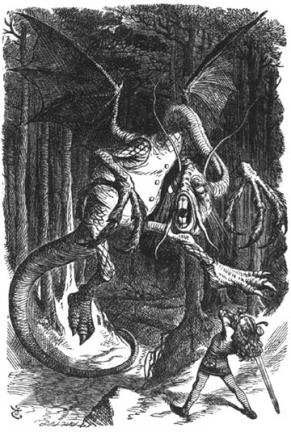
The Jabberwocky is a part of any English student’s cultural baggage, especially ones with some Drama in them too. The Jabberwocky is part of a loved children’s classic, by real people and academics alike. The Jabberwocky is a big ugly beast who never actually shows up in the story. It is as ugly as it is hard to translate (see picture).


First things first: the metre. Why did Carroll choose a three-tetrameter/one-trimeter pattern? Why is the rhyme scheme ABAB? Does it mean something? Look at other nursery rhymes. Is it a recurring feature? Not exactly. The rhymes are though. Good, let’s work on that. It must rhyme. ABAB if possible.

Next thing: read-aloud qualities. This is a brilliant excuse to watch the Disney animated version. And Johnny ‘Mad Hatter’ Depp reciting fragments of it in a creepy Scottish accent. That’s how it should be. Mocking, menacing, mischievous and mildly confusing.

Ok. What to do with the actual words? Transliterate, adapt, replace, or just write some plain Italian nonsense? Hang on, wasn’t there a chapter that explained some of them..? Re-read Humpty Dumpty.

“And ‘the wabe’ is the grass plot round a sun-dial, I suppose?” said Alice, surprised at her own ingenuity.
“Of course it is. It’s called ‘wabe’, you know, because it goes a long way before it, and a long way behind it—”
“And a long way beyond it on each side”, Alice added.
(Lewis Carroll, Through the Looking Glass)

Now that is a brilliant word. Ok, I am going to do this translation following the egg-head’s directions. I’d like it to feel as though it belongs in its book.
So far I have: it must rhyme, the words must be explainable, albeit nonsensically, the sounds must be creepy at moments, soothing at others. Good. Tell you what, I’ll keep the names more or less as they are. A bit of familiarity with previous works, and some casual foreignisation. That’ll keep the academics at bay.

I think I’ve got it. The tenses are the same, the metre is there (with a couple of necessary slips), the rhymes work, not forced or clunky. And the Jabberwocky remains the Jabberwocky.
Now, for the real test: what does my eight-year-old brother think of it?

I guess I failed in my original mission. I might use this in an essay after all.


Alex Valente translates Italian and French into English, and English into Italian. He claims he also works with Old English and Latin. In the little spare time his MA in Literary Translation leaves him, he dumps some poetic reflections onto http://angolopolveroso.wordpress.com (where the Jabberwocky now resides, too). If you really feel the urge to talk to him, you can find him at alex.valente@uea.ac.uk.

Tuesday, 7 December 2010

Attempting to translate «Η φάλαινα που τρώει τον πόλεμο» by Eugene Trivizas(Ευγένιος Τριβιζάς)

Children’s literature is considered by many as literature that is not ‘serious’ and often, people think that writing a book for children, especially a picture book, is an easy task. I couldn’t agree less. I believe that the people who say this, do not take into account how demanding an audience children can be or how easily they get bored or distracted, let alone how challenging it is to write this interesting, gripping story using a limited vocabulary, since, let’s not forget, children tend to have a more limited vocabulary than adults, especially children that will be reading-or have one read to them-a picture book.

That is why, when we were told that for the MA we had to create a small portfolio of translations of texts no-more-than-a-page-long, I thought of translating a picture book. It would be of the perfect length, it would add variety to the portfolio and it would be challenging. I had in mind a specific writer that I wanted to translate, Eugene Trivizas, an author of over a hundred children’s books who is famous for his puns, imaginative and creative use of language and made-up worlds. I chose a book called “The Whale That Eats War” (Η φάλαινα που τρώει τον πόλεμο), simply because it was the last I had read.

The book is about a blue whale that goes to a specific-made up-country every year in order to eat the war. The book has really nice drawings and no more than eight lines per two pages, sometimes just as little as two lines per two pages. It is addressed to children from the age of four. It is a typical example of what makes the translation-and writing, for that matter-of children’s literature challenging. The whole text is made of short rhyming lines full of humourous puns. Trivizas has also made up some words, like the name of the country where the whale goes every spring, which is ‘Varaduay’. Also, in order to achieve rhyme every time, he has, at points, changed the syntax. Finally, and in my opinion this is what makes this book even more challenging than the rest of Trivizas’ books, because it belongs to Trivizas’ anti-war series, and it is about a whale that eats war, it is full of war vocabulary and is populated by different army officials on their special vehicles.

One is prepared to encounter funny rhymes and puns in a children’s book. The made up words and the creative and non-standard use of language is, also, to be expected in children’s fiction. Finally, if the book is a picture book addressed to four-year-olds, one knows that the language she/he can use will be rather limited. So, I guess, ways of working around the syntax to achieve rhyme could be found, and deletion along with compensation could be used in order to produce a text that has the same effects on the audience, pun wise. But, working with the special jargon of war and mentioning the names of different weapons, vehicles and ranks in the army made the translation of this book even the more challenging. And, since the book is about a whale that eats war and belongs to an anti-war series, maintaining the war vocabulary is crucial.

I find that many words used in the Greek text even though they are clearly words related to the war, are much simpler than their equivalents in English and also, happen to rhyme with common every day words, like βλήματα (missiles) and προβλήματα (problems).Another thing that poses a potential problem is that many of the words related to war in Greek, are translated into English in two words as for example,αεροπλανοφόρα and επιλοχίας that translate into aircraft carriers and sergeant major respectively and thus, having two words in the place of one, could affect the rhythm of the text.

The puns, the made-up words, the funny rhymes and the creative use of language are what make Trivizas’ books so fun to read. As a matter of fact, they are so fun that one thinks of Trivizas as a magic person who speaks that way and is always imagining amazing worlds, but, to me, it is clear that they have been written with a lot of thought; with this translation attempt, I discovered just how much thought amounts to a lot of thought. In the end, I did not translate the book, in order to avoid producing a translation that I was not pleased with. I have decided to give it another try when I will have more time and will be able to think of and make up the alternatives that will do it justice.

Avgi Daferera is a translator of English and Spanish into Greek, and Greek and Spanish into English. She just finished an MA in Writing at Warwick and is currently doing an MA in literary translation at UEA. She is interested in the translation of poetry and children’s fiction. You can contact her at adaferer@hotmail.com.

Thursday, 11 November 2010

Translating L’Hirondelle by Claude Simon

Post by Samantha Christie, MALT student

In the Case Studies module of the MA Literary Translation, we have recently been examining children’s fiction and its translation. Focussing on examples of children’s literature in its original and translated versions, and the theories about both writing and translating children’s fiction, we have analysed the genre with specific attention paid to the practicalities of translating it. Amongst other things, we have considered different features of children’s fiction, intra- and extra-textual aspects which might influence its translation, challenges and problems a translator might face in translating this genre, and possible strategies a translator of children’s literature may employ.

Typical, then, that the text I chose for my first practice translation of children’s literature doesn’t contain any of the more prominent challenges for which I have a helpful list of strategies. The text is not written in dialectal language, it contains no slang, there are no ethical issues raised by racist or offensive terms, no songs or limericks, no neologisms…

L’Hirondelle (The Swallow) is a short children’s story, written originally in French by Claude Simon in 1977 and accompanied by Martine Fiere’s colourful, rather abstract images. It follows the journey of a swallow who, whilst flying over a town square, loses a feather, becomes disoriented and starts to fall. In the nick of time, she plucks a feather from the hat of a lady sitting in the square, regains her equilibrium and flies away. It’s a beautiful tale, especially when paired with the illustrations, and I think its beauty lies in the fact it reads so simply. But does a simple story mean a simple translation?

Before starting to translate, I reflected on the text and noted some general aspects to consider. Despite its apparent simplicity, the structure is, in terms of translating, rather complex. The story, at just 16 pages, is very short. As such, the author hasn’t actually used very many words, but doesn’t that mean that the ones he has used are all the more important? So a careful choice of vocabulary was required, particularly with the target audience – children – in mind. The language used is lyrical and there is some rhyme and repetition of words and themes throughout the text. Some passages of text have a certain rhythm to them, although it is not a poem and it doesn’t have a meter. I wanted to keep as much of this rhyme, repetition and rhythm as possible, as it really makes the original flow and the author clearly used that style for a reason.

I hadn’t translated a picture book before, and as the images appear over various parts of the pages, so the text itself has an irregular layout. I needed to make sure my words and pictures were synchronised. I wondered whether the images would have an effect on my translation, whether an image would subconsciously influence my lexical choice. The story also has an iconic element; the movement of the swallow’s flight is mirrored in the text which starts off distanced from the action and zooms in for a close-up before pulling back and returning to where it started.

I’ll give two examples of linguistic areas which I found particularly tricky to translate.
The first line of the text is “Dans un pays il y avait une ville”. ‘Dans un pays’ translates directly as ‘in a country’, which isn’t a very natural thing to say in English. We would normally qualify it in some way: in a different country, in a foreign country, in some country or other. However, the author didn’t need to do that and doesn’t necessarily mean a place that is not ‘this’ country, he just means any country. Introducing a qualifying adjective could technically mislead the reader. On the other hand, the location of the country has no bearing on the tale overall and is non-specific throughout, so the likelihood of this negatively affecting the reader’s understanding is minimal. A further difficulty is by introducing an extra word, the balance and rhythm of the rest of the passage on the first page is upset. This passage is repeated in reverse at the end of the story, so whatever I chose for the beginning needed to fit at the end, too.

Later in the story, when the swallow takes the feather from the hat, she does so “d’un coup d’aile”. Directly, this means ‘with a flap of the wing’, but it also calls to mind another frequently used French expression which sounds similar, ‘d’un coup d’oeil’, meaning ‘at a glance’, ‘a quick look’, and this suggestion of speed in turn calls to mind ‘in the blink of an eye’. I don’t believe the author’s use of “d’un coup d’aile” was entirely coincidental, so needed to find an expression in English that combined the two meanings of ‘with a flap of the wing’ and ‘in the blink of an eye’, which would also fit the rhythm and layout of the text.


Samantha Christie is a translator from French and Spanish into English and is currently working on the MA in Literary Translation at UEA. Special interests include translation in the areas of detective fiction and music, and the relationship between author and translator.
Contact: snchristie@gmail.com